

 English
 French
 German
How to Tell If a Bearing Is Going Bad
CATCH IT EARLY
A bearing rarely fails without warning. It leaves a trail of clues, and that trail starts where an operator can see and hear on a normal walk around the plant.
This guide follows that trail from the sounds and warmth anyone can notice to the checks a technician runs with the machine stopped.
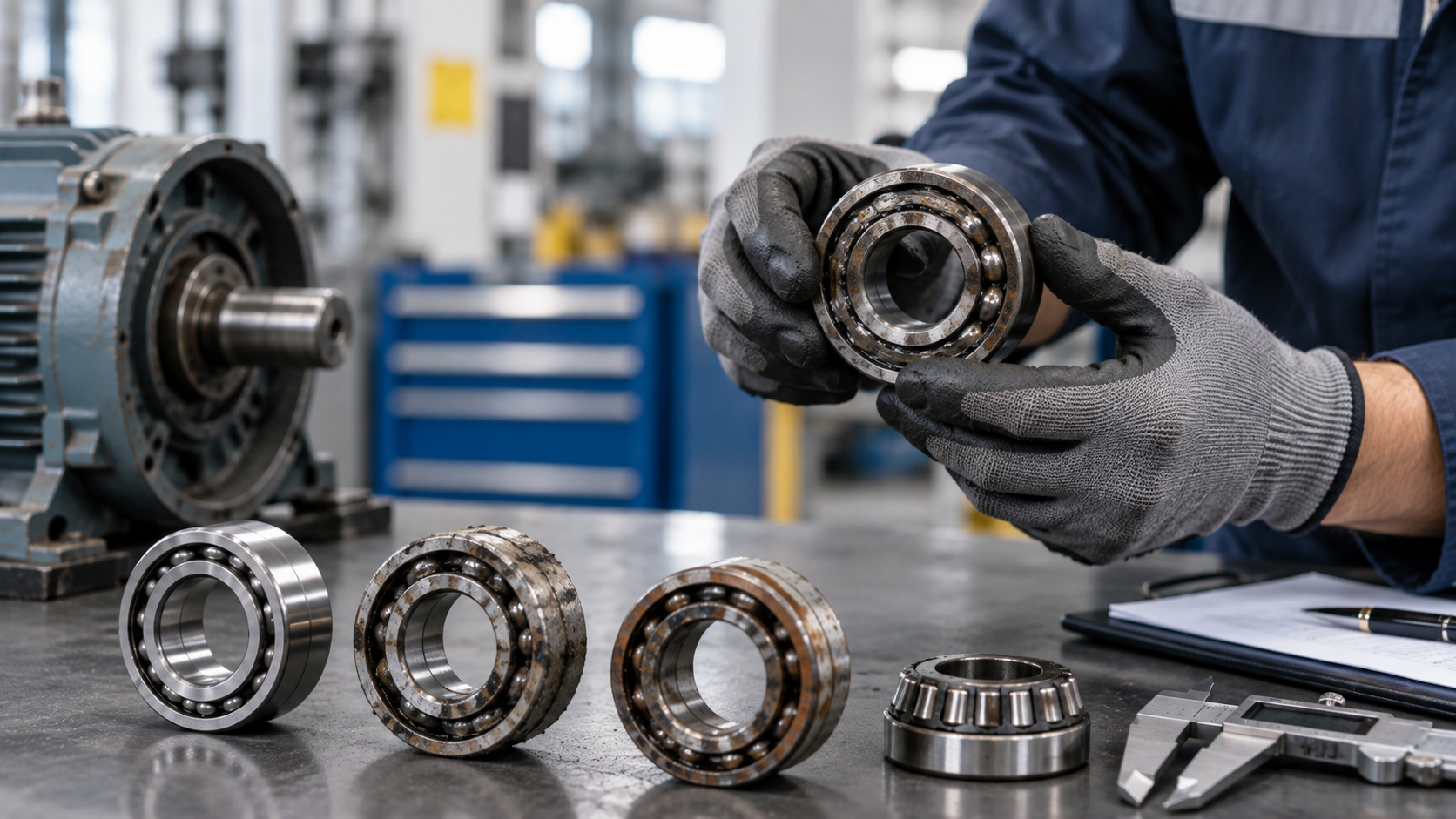
01The Five Signals and What Each One Means
Start with the five signals below. A person can notice each one without special tools, and each points to a different group of causes.
| Signal | What it points to | How urgent |
|---|---|---|
| Noise | Lubrication, raceway wear, contamination | Watch at the next planned stop |
| Heat | Over-greasing, wrong grease, overload, poor fit | Check within the shift |
| Vibration | Raceway damage, misalignment, unbalance | Plan the change, keep reading |
| Roughness or drag | Contamination, spalling, seal drag | Stop and inspect |
| Play | Wear, wrong fits, worn clearance | Schedule the replacement |
Urgency differs by machine. A new sound on a one shift a week machine can wait for the next planned stop, while the same sound on a machine running around the clock belongs in the next window.
02Noise Is Usually the First Clue
Noise is the signal operators report first, and the one most often misread. Ask whether the sound has changed since last month, not whether the machine sounds loud.
Continuous hum versus a repeating tick
A steady hum that grows over weeks usually points to lubrication. Grease that has stiffened or been pushed off the raceway lets the balls run on a thin film. A repeating tick is a different problem, because damage at one spot arrives at a regular beat set by shaft speed.
What a dry bearing sounds like
A dry bearing adds a thin, scratchy quality on top of the normal running sound. It often goes quiet for a moment after fresh grease reaches it and then returns.
When the noise is the housing or the belt instead
A thin housing wall rings, a loose bolt buzzes, and a worn belt can copy a bearing fault closely. Rest a hand on the housing and on the bracket while the machine runs and see which one carries the sound. Our guide to ball bearing noise diagnosis covers the rest of those checks.
03Heat Builds Later Than Noise
Heat arrives later than noise and is harder to ignore. Warmth that creeps up over a shift is a different situation from a housing too hot to touch at start up.
Normal running warmth of a greased bearing
A greased bearing under a normal load warms up and then settles. The housing feels warm to the hand, closer to the outside of a mug than to a radiator. The exact figure depends on load, grease and ambient air, so take the settled temperature of a healthy machine as your reference.
A quick touch test you can do safely
Use the back of your fingers, and only on a surface you already know is safe. If you can hold contact comfortably, the bearing sits in the normal band for most plant equipment. If you pull away at once, confirm with a thermometer before you write it up.
A hot bearing versus a hot housing
A bearing that runs hot passes heat into the housing, so the shaft end warms with it. A hot housing with a cool bearing usually belongs to the process, from a steam line or a motor working harder than usual. Our notes on electric motor bearings cover the checks on that side of the coupling.
04Vibration Is the Signal a Technician Owns
Vibration needs a tool, either a handheld meter or a phone app, and the same measuring point every time.
Why vibration shows up before noise
A small defect on a raceway produces a tiny force each time a ball rolls over it. That force moves the housing by an amount you cannot hear yet, but a sensor picks it up and shows the growth early.
What a phone accelerometer can tell you
Both tools measure overall vibration, which tells you whether the machine is getting worse. Keep the measuring point, direction and speed the same each time, because the trend matters more than any single reading. A simple meter cannot tell you which part of the bearing is failing, because that needs a spectrum.
When the reading points at misalignment
Misalignment, unbalance, a loose foot and a soft foundation all push vibration up, and the bearing simply carries the result. Check the coupling alignment, the balance and the mounting bolts before you order parts.
Most plants work to ISO 20816 for machine vibration, and the alarm and trip levels for your machine come from the machine builder or your own plant standard.
05Roughness, Drag and Play
Turning a bearing by hand
These checks need the machine stopped, locked out and the shaft free to turn. Turn the shaft slowly by hand and feel for grit, catching or a spot where the resistance changes. A healthy bearing turns with light, even drag.
Checking play with a dial indicator
Mount a dial indicator against the shaft and push it back and forth. Compare the movement with the reading from when the machine was new and with the clearance the drawing allows. Growth over time is the signal.
Why a bearing that spins freely can still be finished
A bearing can turn smoothly by hand and still be close to the end of its working life, because hand checks use low speed and almost no load. If the noise and temperature trends are both climbing, trust the trends. The single row design in our deep groove ball bearings range is the one you meet across motors, pumps and conveyors.
06Grease and Seal Clues
What comes out of the seal tells you what is happening inside it. Wipe the housing, run a shift, then look at the seal lip.
Grease color and texture
Fresh grease keeps its color and stays soft. Grease that has turned dark, hardened into a crust or separated into oil and thickener has stopped doing its job, and that is a lubrication problem you can fix before the bearing fails.
Grease thrown out of the seal
A thin ring of grease around the seal after a regrease is normal and wipes off. Grease that keeps escaping for days, on a machine that was not overfilled, points to a worn seal or to pressure inside the housing.
Water or rust at the seal lip
Rust at the seal lip means moisture is reaching the bearing. Washdown, condensation and steam all do this, and once water is inside, the grease breaks down and the raceways start to pit. A sealed bearing with a grease chosen for wet duty handles washdown far better than an open one.
07What to Do About Each Signal
Match the signal to the first action below. The urgency column in the first table still applies while you decide.
| Signal | First action |
|---|---|
| New or changing noise | Regrease to the correct quantity and listen again within the hour. |
| Housing running hot | Check grease type and quantity, then alignment and load. |
| Rising vibration | Recheck the bolts and coupling alignment, then take a spectrum reading. |
| Roughness or drag | Stop the machine, inspect the bearing and the seal. |
| Play beyond the original reading | Replace the bearing and check the shaft and housing fits. |
Bearing type changes the detail of the response. Deep groove ball bearings carry radial loads in motors, pumps, fans and conveyors, and they are the ones most often affected by grease quantity and shaft fit. Crossed roller bearings run in robot joints and rotary tables, and there the first sign is usually lost stiffness or a position error rather than noise.
Our page on crossed roller bearing failure modes walks through those cases. The RAU crossed roller series covers the design we build for those axes.
08Questions Technicians Ask
SEND THE SYMPTOMS
Send us the symptom, the running speed and the machine type. Yuanhe runs both deep groove ball bearings and crossed roller bearings in house, and the replacement spec we send back names the seal, clearance and grease that suit the duty. We supply samples for pilot builds before tooling.