

 English
 French
 German
When Should You Use a Crossed Roller Bearing
When should you use a crossed roller bearing? The answer is simple: use one when a machine needs to rotate under load and hold a precise position at the same time. That sounds narrow, but it covers robot arms, rotary tables, medical scanners, and precision stages. If the design only needs a light shaft to spin, a simpler bearing usually does the job for less. This guide gives you the signals, the applications, and a decision checklist to make the call.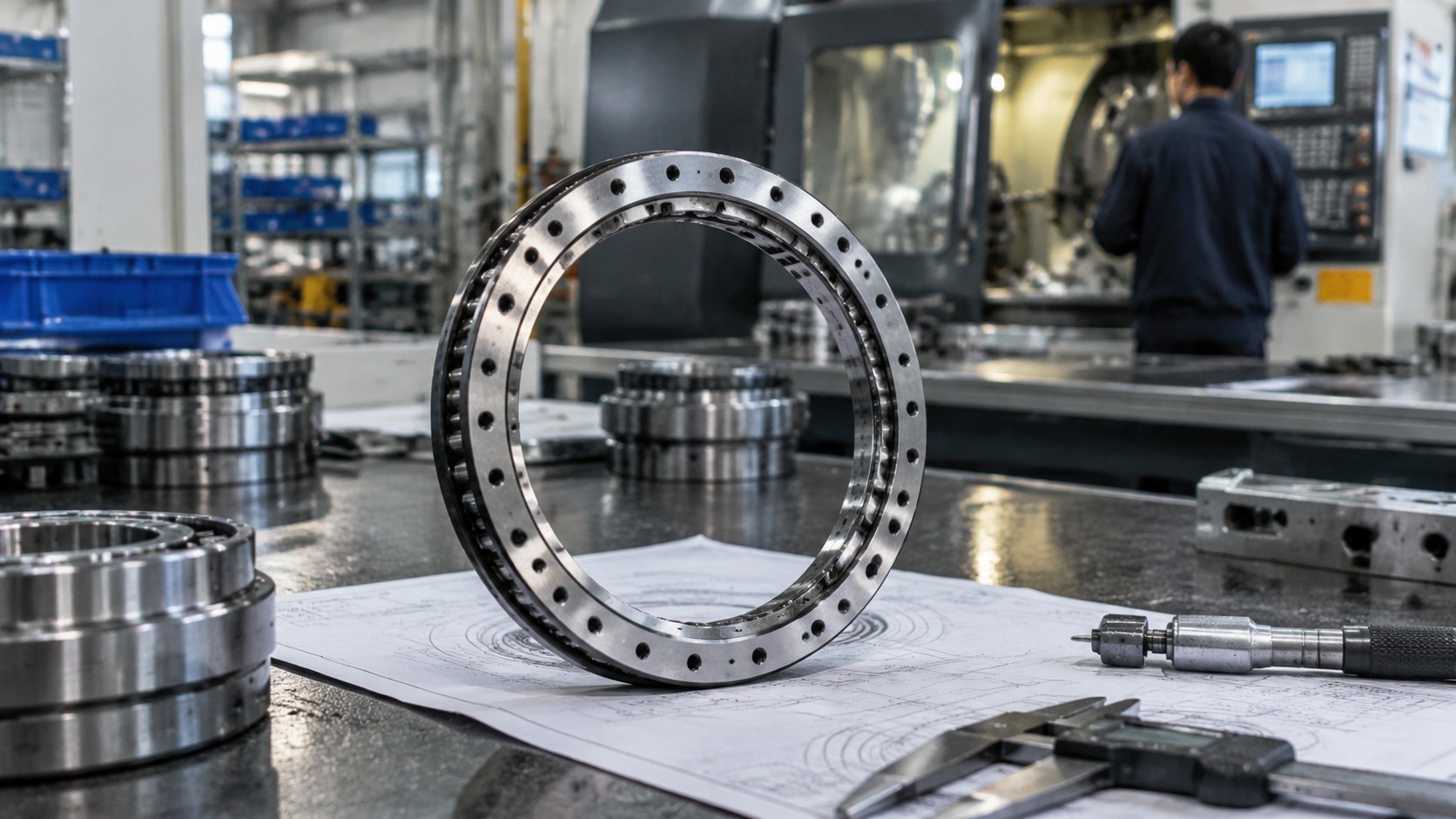
1Signs a Crossed Roller Bearing Is the Right Call
A handful of signals point to a crossed roller bearing. If two or more of these are true, it is likely the right choice.
Combined load. The part carries radial and axial load and a tilting moment, not just one direction. A robot joint lifting a payload at the end of an arm is the classic case. The load direction changes as the arm moves, so the bearing must handle every direction without complaint.
Stiffness matters. The machine cannot tolerate the shaft or table flexing under load. Line contact keeps deflection low. If the tool tip or the workpiece position shifts under load, the result is a bad part, and only a stiff bearing prevents it.
Precision positioning. The rotation must land in the same spot every time. A rotary table indexing a workpiece is unforgiving of wobble. A few microns of runout mean the difference between a good cut and scrap.
Tight envelope. There is no room to stack two bearings. One crossed roller bearing replaces a radial plus a thrust bearing and saves space. That matters in robot joints and scanner gantries where every millimeter is accounted for.
2Applications That Depend on It
Some machines use a crossed roller bearing because nothing else fits the duty. These are the standard cases.
| Machine | Why It Needs the Bearing |
|---|---|
| Robot arm joint | Moment load and stiffness over a long reach |
| CNC rotary table | Accurate indexing under cutting load |
| Medical scanner gantry | Smooth, precise rotation around a patient |
| Precision linear stage | Straight, repeatable motion with no play |
3When a Deep Groove Bearing Is Enough
The opposite case is just as important. Many machines do not need a crossed roller bearing, and paying for one would be waste.
A deep groove ball bearing is the better pick when the load is mostly radial, the speed is high, and positioning tolerance is loose. Electric motors, fans, pumps, and conveyors all fall here. They spin freely, run fast, and do not need the extra stiffness or cost.
The rule of thumb is simple. If the bearing holds a spinning shaft, use a deep groove bearing. If the bearing holds a positioning joint or a table, use a crossed roller bearing. The two roles rarely overlap, and matching the bearing to the role keeps both cost and risk down.
4A Simple Decision Checklist
Work down this list. Each yes pushes toward a crossed roller bearing.
1The load combines radial, axial, and moment.
2The assembly must stay stiff under that load.
3The rotation must repeat to a tight position.
4Space is tight and one bearing must do the job of two.
Two or more yes answers usually mean a crossed roller bearing. One yes or none means a simpler bearing will likely serve. The selection guide turns this checklist into a full specification process.
5Cost and Life Considerations
A crossed roller bearing costs more than a simple deep groove bearing of similar size. That cost buys stiffness, accuracy, and the ability to replace two bearings with one. The right question is not which bearing is cheaper, but which one meets the duty without failing early or producing bad parts.
Life is the other side of the coin. A bearing that is undersized or too soft for the moment load fails early, and the downtime costs far more than the bearing. Sizing the crossed roller bearing correctly means it runs for its full design life with no surprises. The load rating and the accuracy grade are the two numbers to get right.
Sealing also affects life. A sealed bearing in a dusty robot cell lasts longer than an open bearing that eats grit. Choosing the right seal for the environment is part of the life calculation, not an afterthought.
6Mounting and Installation Notes
The best bearing underperforms if it is mounted wrong. A crossed roller bearing wants a flat, clean mounting surface and evenly tightened bolts. A warped housing or uneven bolt torque tilts the ring and ruins the accuracy the bearing was bought for.
Factory-set preload removes the hardest part of the job. You do not adjust internal clearance at install, because it is already set. You just seat the bearing square and torque the bolts evenly. The installation guide walks through the full sequence.
For a sealed bearing, leave the seals alone. They are set to protect the grease for the life of the part. Opening a sealed bearing to re-grease it usually does more harm than good, because it breaks the seal and lets contamination in.
7Comparing the Alternatives at a Glance
When you are deciding between bearing types, a short comparison keeps the tradeoffs straight. Deep groove ball bearings win on speed and cost, and they are the right tool for a spinning shaft. Crossed roller bearings win on stiffness and combined load, and they are the right tool for a positioning joint. The two do different jobs, and mixing them up causes problems in both directions.
Angular contact bearings sit between the two. They handle combined axial and radial load and can be preloaded, but a pair of them is usually needed, and they lack the moment capacity of crossed rollers in a single unit. The comparison with angular contact bearings covers that tradeoff in detail.
The short version: if the part spins, use a ball bearing. If the part positions, use a crossed roller bearing. If the part does both and space is tight, the crossed roller bearing is usually the answer.
8Common Mistakes to Avoid
The most common mistake is using a deep groove bearing where a crossed roller bearing belongs. The joint deflects, the position drifts, and the machine never meets its spec. The fix is to look at the load and the accuracy requirement before picking a bearing, not after the first failed prototype.
The second mistake is undersizing the bearing to save cost. A crossed roller bearing that is too small for the moment load flexes under load and wears early. The downtime costs more than the correct bearing ever would.
The third mistake is opening a sealed bearing to re-grease it. The seal is set for the life of the part. Breaking it lets contamination in and shortens the life you were trying to extend.
9Frequently Asked Questions
How do I know if I need a crossed roller bearing? +
Can I use a deep groove ball bearing instead? +
What is the most common application? +
Not sure which bearing your design needs? Describe the load and we will recommend the right one.