

 English
 French
 German
Ball Bearing Noise Causes Diagnosis and When to Replace
Bearing noise is vibration that happens to fall in the audible range. A healthy deep groove ball bearing hums at shaft frequency. A damaged one ticks, whines, or rumbles at defect frequencies like BPFI and BPFO. This guide covers six root causes, a six-step field diagnosis method, ISO 10816-3 vibration thresholds for when to replace versus regrease, and five prevention measures that eliminate most noise problems before they start.
What Bearing Noise Sounds Like and What It Does Not
Bearings make noise. Some of it is normal. Most of what people call “bearing noise” is not noise at all: it is vibration that happens to fall in the audible range. A healthy deep groove ball bearing running at 3,600 RPM with polyurea grease hums at roughly 60 Hz, the fundamental frequency of shaft rotation. Add cage rattle at 0.35x to 0.45x shaft speed and you get a low purr around 25 Hz. You can feel it more than hear it. Neither is a problem.
Noise becomes a problem when the frequency climbs. A spall on the inner race produces impacts at the ball pass frequency inner race (BPFI). For a 6204 bearing bearing at 1,800 RPM that is roughly 148 Hz with harmonics into the kilohertz range. That is metal hitting metal where it should not. You hear it as a sharp tick, a whine that rises with RPM, or a rumble that does not fade when you pull the load off.
Three sounds to take seriously: a high-pitched squeal changing pitch with speed (inner or outer race spalling), a rhythmic click at shaft frequency (single ball defect or contamination particle being rolled over), and a low rumble getting louder under radial load (raceway brinelling or false brinelling from transit vibration). Each points to a different failure mode. Each gets worse the longer you run it.
Root Causes of Bearing Noise
Bearing noise does not appear at random. It traces to one of six failure mechanisms. Most are preventable.
1
1. Contamination. A single 10-micron silicon carbide particle inside a bearing with 8-micron oil film thickness gouges the raceway on every pass. After a few million revolutions, a spall forms. Contamination enters during mounting (dirty hands, dirty tools, dirty housing), through failed seals, or from degraded grease shedding hardened thickener particles. The failure sound is random ticking, irregular because the particle tumbles. Remove the bearing, flush it with solvent, and listen for debris hitting the catch pan. Sparkles in the solvent mean the bearing was grinding itself away.
2
2. Lubrication breakdown. Grease separates. The base oil bleeds out, the thickener stays as a stiff sponge, and the elastohydrodynamic film collapses. The first audible sign is often a rise in background hum as the bearing runs hotter and the remaining oil thins further. By the time you hear metal-on-metal contact, the raceways are already scored. A bearing running 20 degrees C above its grease upper limit loses roughly half its relubrication interval for every 15 degrees C beyond that threshold.
3
3. Misalignment and poor mounting. A bearing pressed onto a shaft with a hammer and pipe will have brinelled raceways before it turns once. A bearing mounted 0.1 degree out of square concentrates the load onto a narrow band instead of distributing it across the full raceway width. The result: a once-per-revolution thump visible in the vibration spectrum at 1x shaft speed. If misalignment is severe, the cage drags against the balls and you hear a squeal independent of load at the cage frequency, typically 0.35x to 0.45x shaft speed.
4
4. Fatigue spalling. Even a perfectly mounted, perfectly lubricated bearing eventually spalls. Subsurface shear stresses cycle the steel below the raceway until microcracks nucleate, propagate, and pop out a chip. This is normal end-of-life behavior. The difference from contamination spalling is the sound pattern: fatigue starts as a faint, regular tick at BPFI or BPFO that grows louder over weeks or months. Contamination spalling is irregular from the start and progresses faster.
5
5. Electric erosion. Variable frequency drives induce shaft currents that arc across the oil film. Each arc melts a microscopic crater in the raceway. The cumulative damage produces a fluting pattern on the raceway surface. The sound is a high-frequency buzz at the motor carrier frequency, often 4 kHz to 16 kHz. You cannot fix this with better grease. You fix it with insulated bearings or a shaft grounding ring.
6
6. False brinelling. A stationary bearing subjected to external vibration (shipping on a truck, a standby pump next to running equipment) develops polished depressions at the ball-to-raceway contacts. The mechanism is fretting wear, not plastic deformation. The sound on startup is a low rumble that fades after the first few rotations and returns the next time the machine starts. Caught early, the bearing may survive. Ignored, the depressions spall and the bearing fails.
How to Diagnose Bearing Noise in the Field
You do not need a six-figure vibration analyzer to identify a bad bearing. But you do need a method. Here is the sequence experienced reliability engineers follow.
1
Step 1: Safety check. Lock out the equipment. Confirm zero energy. For diagnosing noise on a running machine, do not put your hand or face near rotating parts. Use a stethoscope or a vibration probe on an extension.
2
Step 2: The screwdriver trick. Press the tip of a long screwdriver against the bearing housing. Press the handle against the bone just in front of your ear canal. This is bone conduction. It filters ambient noise and lets you hear mechanical vibration directly. A healthy bearing sounds like a smooth, steady hiss. A damaged bearing sounds like gravel rolling around. Distinct clicks at shaft speed mean a single-point defect. Broadband rumble means distributed raceway wear or contamination throughout the grease.
3
Step 3: Temperature check. Shoot the housing with an infrared thermometer. Compare to shaft temperature and to a known-good bearing on the same machine. A bearing running 15 degrees C hotter than its neighbor under the same load and speed has a problem: overgreasing, undergreasing, or advanced wear generating friction heat.
4
Step 4: Grease sample. If the bearing has a drain plug, catch a small sample. Rub it between your fingers. Gritty means contamination. Black or dark gray means wear debris. A burnt smell means the grease ran too hot. If the consistency is like clay instead of butter, the thickener has hardened and stopped releasing oil. All of these mean the bearing is on borrowed time.
5
Step 5: Vibration measurement. Measure overall RMS velocity in mm/s at the bearing housing, radial direction, over a 10 Hz to 1,000 Hz band. Compare to ISO 10816-3 limits for rigidly mounted medium machines (15 kW to 300 kW): below 2.3 mm/s is normal, 2.3 to 4.5 mm/s is elevated (monitor), 4.5 to 7.1 mm/s means schedule replacement, above 7.1 mm/s means shut it down. Even a smartphone app like phyphox clamped to the housing gives you a rough RMS acceleration reading. It is not calibrated but it will show you the trend.
6
Step 6: Spectrum analysis. If you have an FFT analyzer, capture the vibration spectrum from 0 to 5 kHz. Look for peaks at defect frequencies: BPFO, BPFI, ball spin frequency (BSF), and fundamental train frequency (FTF). Most bearing manufacturers publish these as multipliers of shaft speed. A peak at BPFO with harmonics means outer race spalling. A peak at BPFI with 1x sidebands means inner race spalling. Broadband noise floor elevation above 2 kHz indicates lubrication starvation: the oil film has collapsed and the asperities are contacting.
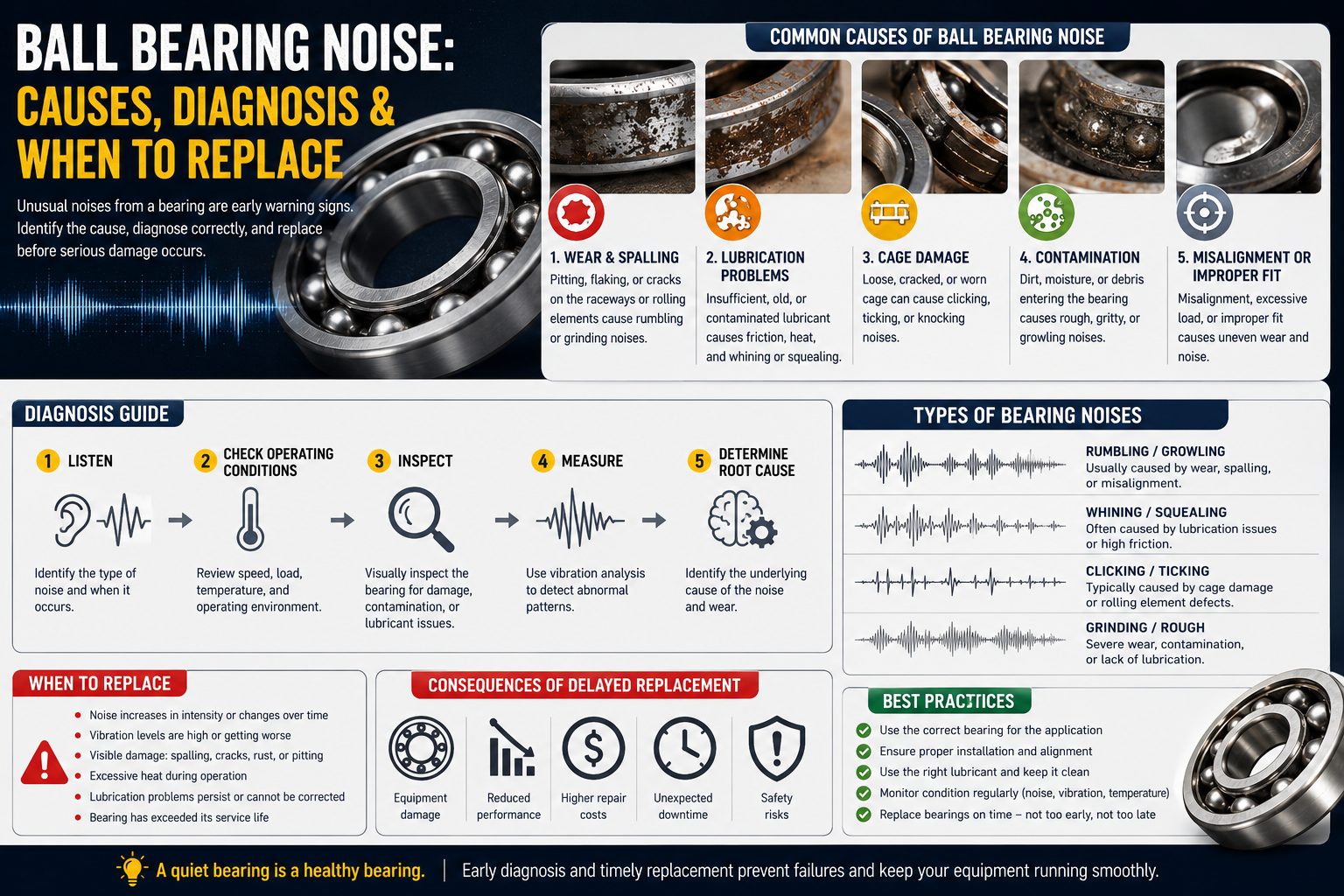
When to Replace vs When to Regrease
Not every noisy bearing needs replacement. The decision splits on three factors: the type of noise, the machine’s role in the process, and how much life is left in the maintenance window.
Regrease
the noise is a smooth hiss or low hum with no distinct clicks. The temperature is elevated but below 85 degrees C on the housing. A grease sample feels dry or stiff but not gritty. Add the correct grease slowly while the shaft turns at low speed. Watch the vent or drain plug. Stop when clean grease appears or when you have added roughly one-third of the bearing free internal volume. Overgreasing churns, overheats, and pushes grease past the seals anyway.
Replace
you hear distinct clicking, ticking, or grinding at any speed. The vibration RMS velocity exceeds 4.5 mm/s on a medium rigid machine. The temperature jumps more than 20 degrees C over baseline in under 24 hours. Or the grease sample feels gritty or comes out black. A bearing with spalled raceways cannot be salvaged by regreasing. You are delaying the inevitable while the spall grows and sends debris through the rest of the bearing. Replacement costs less than a catastrophic failure that takes out the shaft and housing.
The gray zone: a bearing that rumbles intermittently under load, with vibration in the 2.3 to 4.5 mm/s range and no distinct defect frequency peaks. You can run it if the machine can be taken down without stopping production and the next scheduled shutdown is within 30 days. But trend the vibration daily. If RMS rises more than 1 mm/s in a week, the damage is accelerating and the bearing will not make it to shutdown. Order the replacement now.
Preventing Bearing Noise Before It Starts
Most bearing noise is preventable at the specification, mounting, and lubrication stages. None of this is new knowledge. The problem is that it gets skipped under schedule pressure.
Frequently Asked Questions
Can I run a noisy bearing until the next scheduled shutdown? +
What separates bearing noise from gear noise? +
Can switching from grease to oil fix bearing noise? +
How much life remains after a bearing starts making noise? +
Need Bearings for Your Equipment?
Yuanhe manufactures deep groove ball bearings in standard and custom specifications. Send your part number or drawing for a quote. Standard lead time 7 to 15 days.