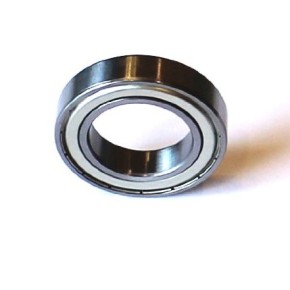


6900 Deep Groove Ball Bearing 10x22x6mm

Ten millimeters is where the 6900 thin-section series begins. The 6900 bearing is the smallest, lightest, and fastest bearing in the series: 10mm bore, 22mm OD, 6mm width, and a dry weight of 9 grams. Three sealing configurations share 2.02 kN dynamic capacity and 0.82 kN static capacity from a single GCr15 ring-and-ball platform. At 34,000 RPM in Open configuration, it is the highest-speed bearing in the 6900 series. This combination of minimal envelope and high speed defines the 6900 bearing role: micro-motors, dental and surgical handpieces, miniature spindles, and any application where the bearing itself must not dictate the product size.

Key Specifications

  • Sealing: Open, ZZ (SPCC metal shields), and 2RS (NBR contact seals). Open reaches 34,000 RPM. ZZ retains full speed. 2RS limits to ~27,000 RPM due to seal lip friction at the 10mm bore scale.
  • Load: 2.02 kN dynamic (Cr) and 0.82 kN static (Cor). This is the series baseline. The 6901 bearing at 12mm bore delivers 2.89 kN (43% more) for a 2mm bore increase.
  • Speed: 34,000 RPM (Open/ZZ). At 10mm bore, the ball pitch diameter is approximately 16mm, giving a DN value of 544,000. Standard polyurea grease supports this without oil-mist supplementation in Open configuration.
  • Temperature: -20C to 120C with standard polyurea grease. The small thermal mass of the 6900 bearing means it reaches thermal equilibrium faster than larger bearings; clearance selection must account for this at elevated speeds.
  • Material: GCr15 chrome steel (AISI 52100 equivalent). 440C stainless steel for dental autoclave and medical environments. Hybrid ceramic (Si3N4 balls) for speeds exceeding 40,000 RPM in specialized spindle applications.

For any inquiries, please contact with our Supporting Team at sales@yuanhecd.com.

6900 Bearing

Bore x OD x Width

10x22x6 mm

Dynamic Load (Cr)

2.02 kN

Static Load (Cor)

0.82 kN

Max Speed

34,000 RPM

Weight

9 g

Sealing

Open / ZZ / 2RS

695 ZZ miniature deep groove ball bearing 5x13x4mm double metal shielded
Model 6900
Type Open / Shielded / Sealed
Bore Dia. 10 mm
Outside Dia. 22 mm
Width 6 mm
Weight 9 g
ABEC Tolerance ABEC-3
Dynamic Load Capacity 2.02 kN
Static Load Capacity 0.82 kN
Max. RPM 34,000 RPM
Temp. Range -20~120 C
Material GCr15 Chrome Steel
Seal / Shield Material NBR rubber (2RS) / SPCC steel (ZZ)
Lubrication Polyurea grease (standard)

Sealing and Lubrication

At 10mm bore, the seal friction-to-torque ratio is more favorable than on larger bearings because seal lip circumference is only 31mm. This means the 6900 2RS bearing retains 27,000 RPM; a 6903 2RS bearing at 17mm bore drops to 17,000 RPM from the same 22,000 RPM open speed. The percentage speed retention in 2RS configuration improves as bore size decreases.

The 6900 Open bearing is the default configuration for dental handpieces, miniature spindles, and micro-motors where the bearing runs inside a sealed housing. Oil-mist lubrication at 0.5-1.0 cc/hour sustains 34,000 RPM indefinitely. The open configuration also enables re-greasing through the exposed ball path, which is essential for tools that run 8-10 hours a day in dental clinics and PCB drilling stations.

The 6900 ZZ bearing uses SPCC steel shields with a 0.10-0.20mm labyrinth gap at the inner ring shoulder. At 10mm bore, this gap represents roughly 0.3% of the bearing OD; particles larger than 0.10mm cannot enter. ZZ is the right choice for office equipment, 3D printer extruders, and enclosed fan motors where the bearing is assembled into a clean housing and needs no relubrication for the product lifetime.

The 6900 2RS bearing uses NBR contact seals. The 31mm seal circumference at 10mm bore generates roughly 40% less friction heat than the 38mm seal on a 6901 2RS bearing at the same RPM. This is why the 2RS speed penalty is proportionally smaller on the 6900 bearing. Choose 2RS for dental handpiece turbine cartridges exposed to steam sterilization, outdoor drone motors, and medical pumps where the bearing faces direct fluid contact.


Performance

At 2.02 kN dynamic load, the 6900 bearing is the series entry point. It carries a 10mm shaft at 34,000 RPM in a package weighing 9 grams. For context, the 6000 bearing also fits a 10mm shaft but measures 10x26x8mm (4mm larger OD, 2mm wider) and weighs 19 grams; more than double. The 6000 bearing carries 4.58 kN dynamic (127% more), but if the housing bore is fixed at 22mm and the load is under 2.0 kN, the 6900 bearing is the only standard deep groove option that fits.

The 6mm width is shared with the 6901 bearing. This means the 6900 bearing and 6901 bearing are interchangeable in width-constrained applications; only the bore and OD differ by 2mm each. A design that starts with a 6900 bearing (10mm shaft) can be upgraded to a 6901 bearing (12mm shaft) by reboring the housing from 22mm to 24mm and increasing the shaft diameter by 2mm. The 6mm axial envelope stays constant across both bearings. This modularity is one reason the 6900 series is popular in product families where multiple power levels share a common gearbox housing.

ABEC-3 radial runout of 0.010mm is standard for the 6900 bearing. At 34,000 RPM, this translates to a vibration displacement amplitude of approximately 0.003mm at the outer ring; below the threshold where audible bearing noise becomes perceptible in a quiet office or medical environment. For dental handpieces and PCB drilling spindles where runout directly affects cut quality, ABEC-5 (0.006mm runout) is available on OEM order.


OEM and Customization

Yuanhe supplies the 6900 bearing with C3 radial clearance and polyurea grease as standard. Four customization paths serve the most common application-specific requirements at the 10mm bore scale:

Clearance: C2 for ultra-low-noise dental and medical devices where vibration directly affects patient perception and procedure accuracy. C4 for miniature motors that run at 80C+ continuously and close clearance through differential expansion of the aluminum housing relative to the steel bearing rings
Grease: Low-noise polyurea (Kluber Isoflex NBU 15 or equivalent) reduces running noise by 4-6 dB versus standard polyurea; essential for dental handpieces where bearing noise travels through the tool body to the patient ear. Fluorinated grease for vacuum environments in semiconductor wafer handling. NSF H1 food-grade grease for pharmaceutical filling and packaging equipment
Cage: Standard pressed steel. PA66-GF glass-reinforced polyamide cage cuts rotating mass below 9 grams and reduces inertia for rapid start-stop cycles in pick-and-place robots and camera gimbal motors. Brass machined cage for continuous vibration in handheld surgical tools
Material: 440C stainless steel for autoclave-sterilized dental handpieces (1,000+ steam cycles at 134C). Hybrid ceramic with Si3N4 balls for electrical insulation and speeds above 40,000 RPM in dental turbine cartridges and PCB drilling spindles. Full-ceramic ZrO2 for non-magnetic MRI-compatible surgical robots

MOQ for modified clearance or specialty grease starts at 500 pcs. Submit your bearing drawing for a quote with lead time and batch certification terms.
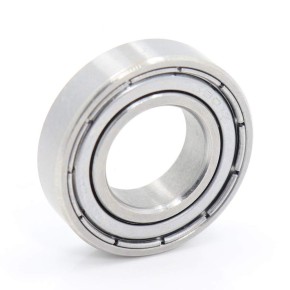

Applications

Dental handpiece turbine cartridges
Surgical micro-drills and bone saws
PCB drilling and routing spindles
Miniature BLDC motors below 50W
3D printer extruder and hot-end drives
Camera gimbal and drone propulsion motors
Medical infusion and peristaltic pumps
Semiconductor wafer handling robots
Pick-and-place machine Z-axis spindles
Miniature centrifugal fans and blowers

Frequently Asked Questions

6900 bearing vs 6000 bearing: which one fits a 10mm shaft with the smallest housing envelope? +
Both bearings fit a 10mm shaft. The 6900 bearing measures 10x22x6mm and weighs 9 grams. The 6000 bearing measures 10x26x8mm and weighs 19 grams. The 6900 bearing saves 4mm in OD, 2mm in width, and 10 grams in weight; a 50% weight reduction and a 28% smaller radial cross-section. The trade-off is load capacity: the 6900 bearing carries 2.02 kN dynamic versus 4.58 kN for the 6000 bearing. If the housing bore is fixed at 22mm OD and the radial load is under 2.0 kN, specify the 6900 bearing. If the housing can accept a 26mm bore and the application needs the 4.58 kN load margin, the 6000 bearing is the right choice. The two bearings are not interchangeable in the same housing without re-machining. Contact us with your envelope constraints.
How does the 6900 bearing achieve 34,000 RPM, and what limits it from going higher? +
The 34,000 RPM ceiling for the 6900 Open bearing is determined by the ball complement dynamics, not by the grease. At 10mm bore, the ball pitch circle diameter is approximately 16mm, giving each ball an orbital velocity of about 28 m/s at 34,000 RPM. Beyond this speed, centrifugal force on the balls increases cage pocket wear and can cause ball skidding on the inner ring during rapid acceleration. The DN value (bore in mm times RPM) is 340,000; standard deep groove bearings are typically rated to DN 500,000-600,000 with oil-mist lubrication. The 6900 bearing can reach 40,000 RPM in Open configuration with hybrid ceramic (Si3N4) balls and oil-mist lubrication, as the lower ball mass reduces centrifugal loading by roughly 60%. OEM orders for hybrid 6900 bearings with ABEC-5 precision support sustained operation at 40,000-45,000 RPM.
How does grease service life differ in a 6900 bearing compared to larger bearings in the series? +
Grease life in a rolling bearing scales inversely with speed and temperature, not with bearing size. At the same RPM and temperature, a 6900 bearing and a 6905 bearing filled with the same grease will have similar grease life measured in hours. However, the 6900 bearing reaches its operating temperature faster because its 9-gram mass has approximately one-tenth the thermal capacity of a 6905 bearing (roughly 90 grams). In a start-stop application, the 6900 bearing cycles through thermal expansion more frequently, which can accelerate grease degradation at the raceway margin. The practical implication: for 6900 bearings running above 25,000 RPM, specify the grease fill at 20-25% of free volume rather than the standard 25-35%. The lower fill reduces churning torque and heat generation at the expense of shorter relubrication intervals. For continuous-duty applications above 30,000 RPM, oil-mist lubrication at 0.3-0.5 cc/hour eliminates the grease life constraint entirely.
Why does the 6900 bearing weigh only 9 grams, and when does every gram count? +
The 6900 bearing dry weight of 9 grams comes from its compact envelope: rings with a 6mm radial cross-section (22mm OD minus 10mm bore, divided by two), 6mm width, and a ball complement of typically 8-10 balls at 3.175mm diameter. The 6000 bearing at the same 10mm bore weighs 19 grams because its thicker ring cross-section (8mm radial) and wider envelope (8mm width) use more steel. The 10-gram weight difference matters in three application classes. First, high-RPM handpiece turbines where the bearing mass directly contributes to gyroscopic torque felt by the operator; a lighter bearing means less wrist fatigue over an 8-hour clinical day. Second, drone and camera gimbal motors where bearing weight is unsprung mass that the flight controller must accelerate and decelerate thousands of times per second for stabilization. Third, battery-powered handheld tools where every gram saved in the drivetrain extends run time or allows a smaller battery. In a product with four 6900 bearings (two per shaft, dual-shaft gearbox), the weight savings versus four 6000 bearings is 40 grams; meaningful in a tool targeting a 500-gram total weight.

Related Products

6901 ZZ

Small ball bearing

6903 2RS

Deep Groove Ball Bearing

6904 2RS

Double Seal Ball Bearing

6905 ZZ

Thin Section Bearing

Looking for a reliable OEM manufacturer?

Talk to Our Engineering Team