

 English
 French
 German
Why We Upgraded the RAU Series for High-Rigidity Cobot Joint Actuators
This post explains why Yuanhe upgraded the RAU series for high-rigidity cobot joint actuators, and what each change does for joint stiffness. The load case is the reason. A cobot joint actuator carries moment loads, and moment stiffness comes from preload and ring structure more than from bearing size. Yuanhe crossed roller bearings sit at the output of the actuator, where the weight of the link and the force at the tool tip act on one compact ring set. Cylindrical rollers arranged at 90-degree alternating angles in V-shaped raceways let a single bearing carry radial, axial, and overturning moment loads at the same time.
Yuanhe builds the RAU series around two architectural choices: integrated one-piece inner and outer rings, and preload set at the factory. Both choices serve one goal, which is stiffness that repeats from one unit to the next. The latest upgrade pushed both choices further instead of replacing them. This article walks through the load case, the design response, and the questions joint builders ask before they specify.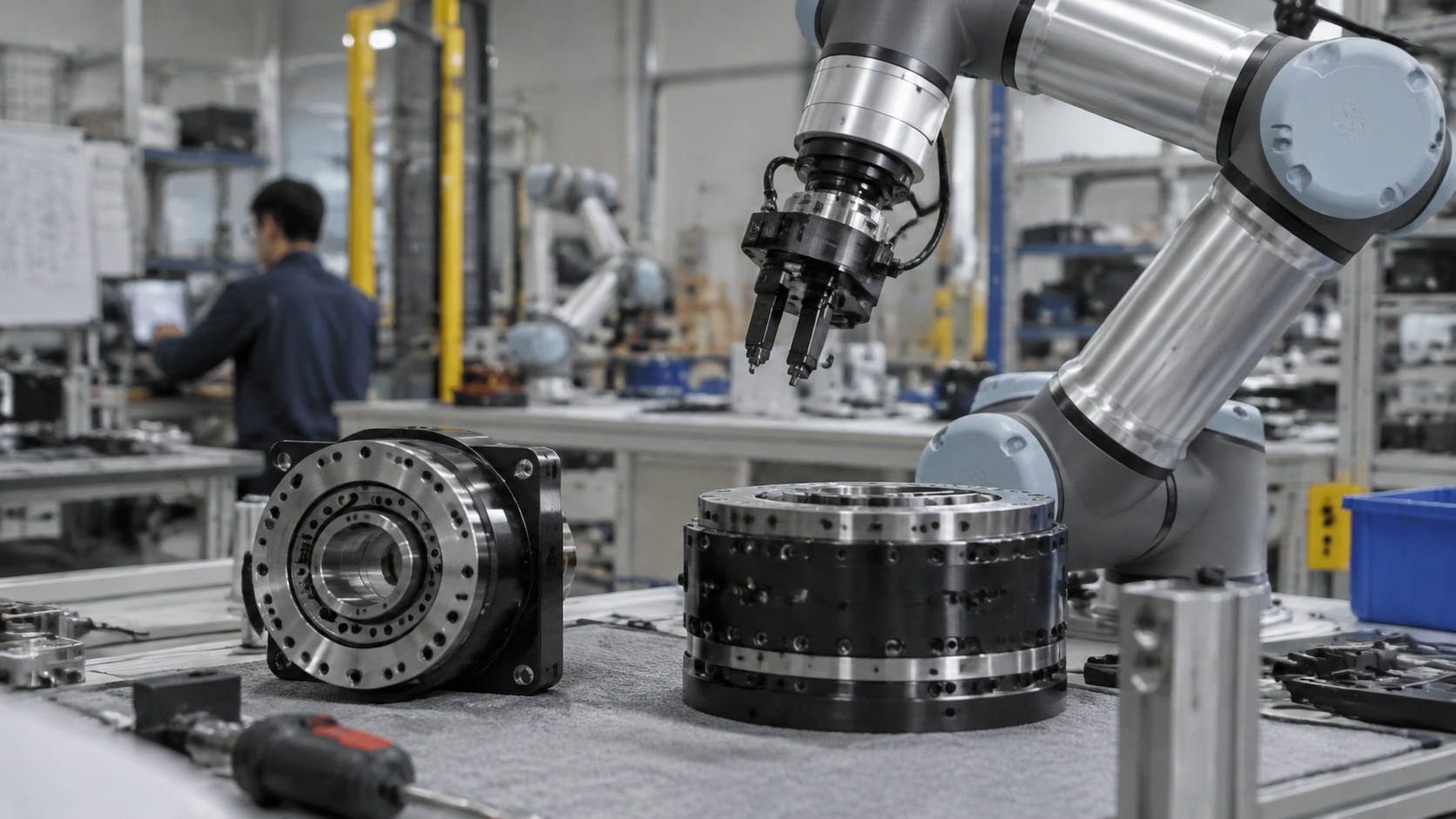
01The Load Case Inside a Cobot Joint Actuator
A joint actuator in a collaborative robot does not spin like a motor shaft. It rotates over a limited arc and reverses direction constantly. The tool tip carries the payload, so the output bearing sees an overturning moment that changes as the arm moves. When the robot holds position against gravity, the same bearing holds the load still. None of these phases tolerates free clearance, because play at the bearing becomes visible error at the tool tip.
Contact events add a second demand. Safety-rated robots detect a collision and stop, but the bearing must survive the impulse before the drive reacts. This pushes the design toward rollers instead of balls. Rollers make line contact with the raceways, so the load spreads over a larger area and deflection stays lower under the same moment.
What the output bearing must manage
- Overturning moment from link weight and tool forces
- Radial and axial loads that arrive at the same time
- Reversing motion with no free clearance at direction change
- Impulse loads from contact events before the drive stops
02Moment Stiffness Comes From Structure and Preload
Moment stiffness is resistance to tilting under an applied moment. In a crossed roller bearing it comes from three places. The first is geometry. Cylindrical rollers sit at 90-degree alternating angles in V-shaped raceways, and each roller makes line contact with both rings. The second is the ring set. A one-piece integrated ring deforms less than a clamped split ring, because there is no joint to open under load. The third is preload. Factory-set preload keeps every roller in contact with both raceways, so a load reversal never crosses a clearance zone.
The result is measurable. Yuanhe rates the moment stiffness of its crossed roller bearings at three to five times that of an equivalent ball bearing. For a cobot joint this changes the frame of reference. A designer who needs a stiff joint does not reach for a larger bearing. He or she specifies the right roller geometry, then verifies preload and runout.
The table maps each joint demand to the RAU design response.
| Joint demand | RAU design response |
|---|---|
| Moment and axial loads in a slim envelope | V-shaped raceways with 90-degree alternating rollers in a thin rectangular cross-section |
| No play at load reversal | Factory-set preload holds every roller in contact with both raceways |
| Unit-to-unit consistency on the assembly line | Preload set at the factory, with no field adjustment step |
| Simple, repeatable mounting | Integrated one-piece rings, so there are no split-ring bolts to torque |
| Even load sharing under moment | High-density roller complement packed into the V-groove |
| Verifiable accuracy | Bore tolerance, radial runout, and assembly height checked at four quadrant positions |
03What We Changed and Why
The upgrade concentrated on the three elements that control stiffness and consistency. Each change is small in isolation and large in the tolerance chain.
1Ring structure. Integrated inner and outer rings
The RAU series uses one-piece inner and outer rings. There is no split ring and no clamping bolt. The raceway is ground into a solid ring, so it cannot open, shift, or relax after assembly. Split-ring designs need the outer ring clamped around the rollers during mounting, which adds assembly clearance to the chain and leaves the final preload dependent on the person at the bench. RAU removes that step. The difference between integrated and separated ring designs decides how much of the joint stiffness survives assembly.
2Preload. Set at the factory, not on the line
Preload is the heart of the upgrade. RAU bearings ship with preload already set, and no field adjustment is needed. This matters most in production. A joint builder who fits a clearance bearing must measure, shim, or adjust every unit to reach the same stiffness. With factory preload the bearing arrives with consistent preload and runout accuracy from the first installation, so assembly simplifies to a fit-and-fix step. What bearing preload is and why it matters covers the mechanics behind this choice.
3Roller complement. High density with a spacer retainer
Rollers are packed at high density into the V-groove raceway and held by a spacer retainer. High density means more line contacts share the applied moment, which lowers the load on each roller. The spacer keeps every roller on its own pitch, preventing skew and keeping the load pattern stable through oscillation and reversal. The retainer also simplifies handling, because the roller set stays together as a unit.
04What the Upgrade Means at the Joint Level
Taken together, the changes shorten the mechanical chain inside the joint. One RAU ring set does the work that otherwise needs paired angular contact bearings or a thrust-plus-radial arrangement. Compared with those pairs, the single unit reduces part count, removes the field preload adjustment, and fits into roughly half the axial space.
The accuracy budget is where a robot pays for bearing play. A deflection at the bearing grows into a larger error at the tool center point, so the bearing decides how much of the gear accuracy survives to the tool tip. Yuanhe specifies robot-joint crossed roller bearings to keep tool center point deflection under 0.01mm at full payload across articulated arm, wrist, and shoulder axes. The internal layout of a robot joint explains where this stiffness is spent.
RAU is available from 20mm to 350mm bore with standard precision grades P5, P4, and P2. Every bearing ships with dimensional inspection data, with bore tolerance, radial runout, and assembly height verified at four quadrant positions. A stiff bearing you cannot verify behaves no better than a loose one you can, so the data sheet is part of the rigidity story. What P5, P4, and P2 mean is worth a read before you set the grade on your drawing.
05Questions We Hear About the RAU Series
Q1What exactly changed in the upgrade?
The architecture stayed RAU: integrated one-piece rings, spacer retainer, factory preload. What changed is how far each element is pushed. Roller density, preload consistency, and the verification data shipped with every bearing were tightened so the series meets the moment and accuracy demands of cobot joint actuators as a standard offering, not as a special order.
Q2What is the difference between RAU, RB, and RE crossed roller bearings?
RAU bearings use integrated one-piece inner and outer rings with a spacer retainer, and both rings are solid with no split. RB bearings have a split outer ring that clamps together after roller installation, with an integrated inner ring. RE bearings have a split inner ring with an integrated outer ring. RAU is the simplest to mount because there are no split-ring bolts to torque and no assembly clearance to manage.
Q3Does factory preload raise friction?
Any preloaded bearing has higher starting torque than a clearance bearing. The trade is deliberate: what you give up in drag you gain in deflection control. RAU preload is set at the factory and consistent from unit to unit, so the drag measured on the first sample is the drag you get in production. If a joint runs at minimum drag targets, share the duty cycle before specifying.
Q4Which precision grade should a cobot joint use?
RAU covers P5, P4, and P2. The right grade follows the accuracy budget of the arm, not the size of the bearing. P2 holds the tightest runout of the three and is a common choice where the bearing sits close to the tool tip. P5 fits larger shoulder and base joints where the moment dominates and the tolerance chain is longer.
Q5Can we switch an existing joint to RAU without redesigning the housing?
Usually yes, because RAU keeps the thin rectangular cross-section and standard mounting dimensions of the crossed roller envelope. Compare bore, outer diameter, width, and lubrication hole position against the current drawing. Yuanhe has completed 12,000+ OEM projects on drawing-based review, so send the drawing and the engineering team confirms fit before you touch the housing.
06Key Points Before You Specify
- Moment stiffness comes from roller geometry, ring structure, and preload, not from envelope size
- Integrated one-piece rings remove the assembly clearance of split-ring designs
- Factory-set preload makes stiffness repeat from unit to unit without field adjustment
- Ask for the inspection data, with bore tolerance, radial runout, and assembly height at four quadrant positions
CTASend the joint envelope and load case to Yuanhe.
Describe the arm, the moment at the output, and the accuracy target. The engineering team replies with a RAU selection and a quote. Yuanhe has supplied crossed roller bearings to 500+ B2B clients across 30+ countries, and every project starts the same way, with the drawing. Contact Yuanhe with your joint specification.