


 English
 French
 German
Crossed Roller Bearings vs Ball Bearings. Which One Fits Your Application
Crossed roller bearings vs ball bearings is a choice about stiffness, load, and space. A ball bearing handles a spinning shaft cheaply and fast. A crossed roller bearing holds a rotating joint steady under combined load. Picking the wrong one shows up as deflection, early wear, or a machine that never meets its accuracy spec. This guide lays out the difference and how to decide which fits your application.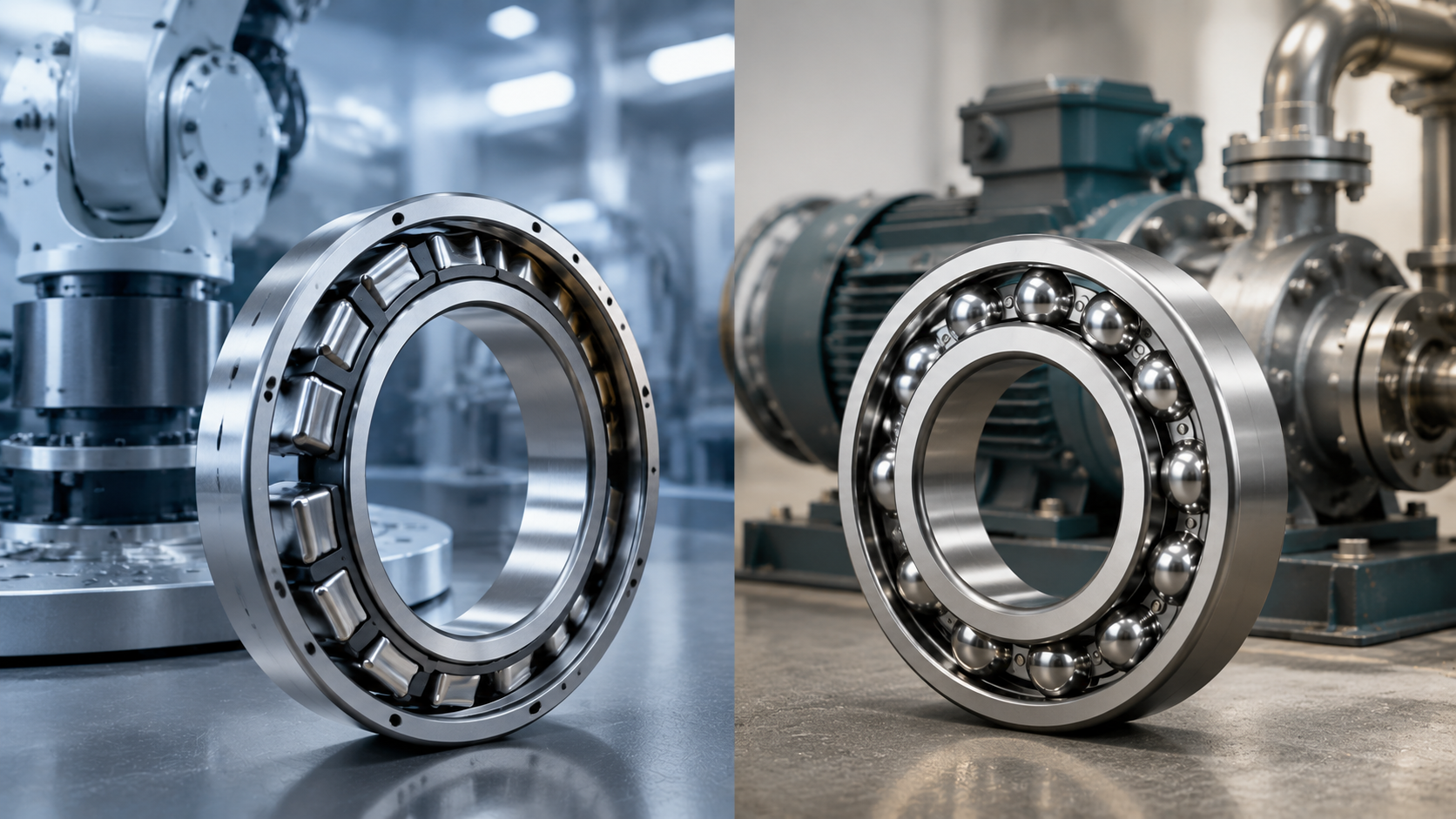
1The Core Difference Is Contact
The two bearings differ in how their rolling elements touch the raceway. A ball touches at a point. A roller touches along a line. That single difference drives almost everything else.
Line contact spreads the load over more area than point contact. The result is that a crossed roller bearing deflects less under the same force. It is stiffer, and it carries more load in the same envelope. A deep groove ball bearing spins faster and cheaper but flexes more when the load climbs.
2Load Direction and Stiffness
A ball bearing is a specialist at radial load. It handles the weight pushing across a shaft well, takes a little axial load, and resists almost no tilting moment. That is fine for a motor, a fan, or a pump, where the shaft spins in a straight line and nothing tries to tip it over.
A crossed roller bearing handles radial load, axial load, and tilting moment all at once. The rollers alternate at right angles, so one set catches force in one direction and the crossed set catches the moment that tries to tip the assembly. A robot arm leaning out from its base is the classic case. The joint bearing must resist a big tilting force without flexing, and a ball bearing simply cannot keep up.
3Speed, Friction, and Cost
Here the ball bearing wins. Point contact means low friction, so ball bearings run at higher speed and run cooler. They are also simpler to make, which keeps the cost down. For a high-speed spindle or an electric motor, the ball bearing is the right tool.
The crossed roller bearing trades some speed and cost for stiffness and combined load. It is not the bearing for a motor spinning at thousands of revolutions per minute. It is the bearing for a joint that rotates slowly, stops precisely, and holds position under load.
4Side-by-Side Comparison
| Factor | Ball Bearing | Crossed Roller Bearing |
|---|---|---|
| Contact | Point | Line |
| Load direction | Mostly radial | Radial, axial, and moment |
| Stiffness | Lower | Higher |
| Speed | Higher | Lower |
| Cost | Lower | Higher |
5Which One Fits Your Application
Match the bearing to the role. If the part is a spinning shaft, a ball bearing is the answer. If the part is a positioning joint or a table that must stay stiff under moment load, a crossed roller bearing is the answer. The two roles rarely overlap.
1High speed, light shaft, loose tolerance? Choose a ball bearing.
2Combined load and moment, tight position? Choose a crossed roller bearing.
3Tight space and one bearing must do two jobs? The crossed roller bearing usually wins.
The stiffness and accuracy comparison goes deeper into the numbers, and the selection guide turns this decision into a full specification process.
6Materials and Life
Both bearing types use hardened bearing steel for the rings and rolling elements. The material choice follows the environment. Standard GCr15 chromium steel covers most duty, while stainless steel steps in for corrosive or cleanroom conditions. Stainless resists rust but carries slightly less load than chromium steel.
Life is where the two bearings differ most. A ball bearing sized correctly for a spinning shaft runs for a very long time, because its load is light and its friction is low. A crossed roller bearing under a heavy moment needs to be sized right, because an undersized one flexes and wears early. In both cases, the load rating is the number that decides the life, not the bearing type.
7Common Mistakes When Choosing
The most common mistake is using a ball bearing where a crossed roller bearing belongs. The joint flexes, the position drifts, and the machine never meets its spec. The reverse mistake, using a crossed roller bearing on a fast motor shaft, costs too much and adds friction for no benefit.
The second mistake is undersizing to save money. A bearing that is too small for the moment load wears early, and the downtime costs more than the correct bearing ever would. Match the load rating to the actual load, with a margin for shock, and let the bearing run its full life.
8Examples in Real Machines
A few real cases make the choice concrete. An electric motor uses a ball bearing, because the shaft spins fast and the load is light. A CNC rotary table uses a crossed roller bearing, because the table indexes a workpiece under cutting load and must hold a precise angle. The two machines look nothing alike, and neither would work well with the other’s bearing.
A robot arm uses both. Its drive motors spin on ball bearings, while its rotating and tilting joints ride on crossed roller bearings. That mix is common in one machine, and it shows why the question is not which bearing is better, but which one fits each position in the design.
9Making the Final Call
The final decision comes down to two questions. What is the load direction, and how fast must it spin? A mostly radial, high-speed load points to a ball bearing. A combined load with a tilting moment points to a crossed roller bearing. Once you answer those two questions, the bearing picks itself.
Space and cost are the tiebreakers. If one crossed roller bearing replaces a radial bearing plus a thrust bearing, it often wins on both even at a higher unit price. If a ball bearing meets the spec and the extra stiffness is wasted, the cheaper bearing is the right one. The goal is never the fanciest bearing; it is the one that meets the duty without overpaying.
10Key Points to Remember
Point contact vs line contact. Ball bearings touch at a point and run fast. Crossed roller bearings touch along a line and stay stiff under load.
Match the role. Spinning shafts use ball bearings. Positioning joints and tables use crossed roller bearings.
Do not overpay. Pick the bearing that meets the load, speed, and accuracy the machine actually needs, nothing more.
11The Bottom Line
Crossed roller bearings vs ball bearings is not a contest with a single winner. Each bearing is the right answer for a different duty. A ball bearing spins a shaft fast and cheap. A crossed roller bearing holds a joint stiff and accurate under combined load. Knowing which duty your position faces is the whole decision. Choose the bearing that fits the role, size it for the real load, and the machine will run as designed.
12Frequently Asked Questions
Is a crossed roller bearing just a ball bearing with rollers? +
Can I use a ball bearing in a robot joint? +
Which costs more? +
Can the two bearings work together in one machine? +
Not sure which bearing your design needs? Describe the load and we will recommend the right one.