

 English
 French
 German
Crossed Roller Bearing Backlash and Factory Preload in Robot Joints
Crossed roller bearing backlash in a robot joint appears at the output flange as lost motion. Drive the axis one way, reverse the direction, and the flange does not follow until the play inside the bearing closes. On an assembly robot that repeats the same path thousands of times per shift, that play shows up as position error at the tool tip. Engineers choose RAU series crossed roller bearings for robot joints largely because the design removes the known sources of this play before the bearing ever reaches the machine.
This article follows the same logic a joint engineer uses: trace where backlash comes from, show how each source degrades joint repeatability, and explain how factory preload in an integrated-ring design closes the loop. Yuanhe crossed roller bearings arrange cylindrical rollers at 90-degree alternating angles in V-shaped raceways, with line contact across both rings. That geometry is the base; preload is what makes it behave like a rigid joint.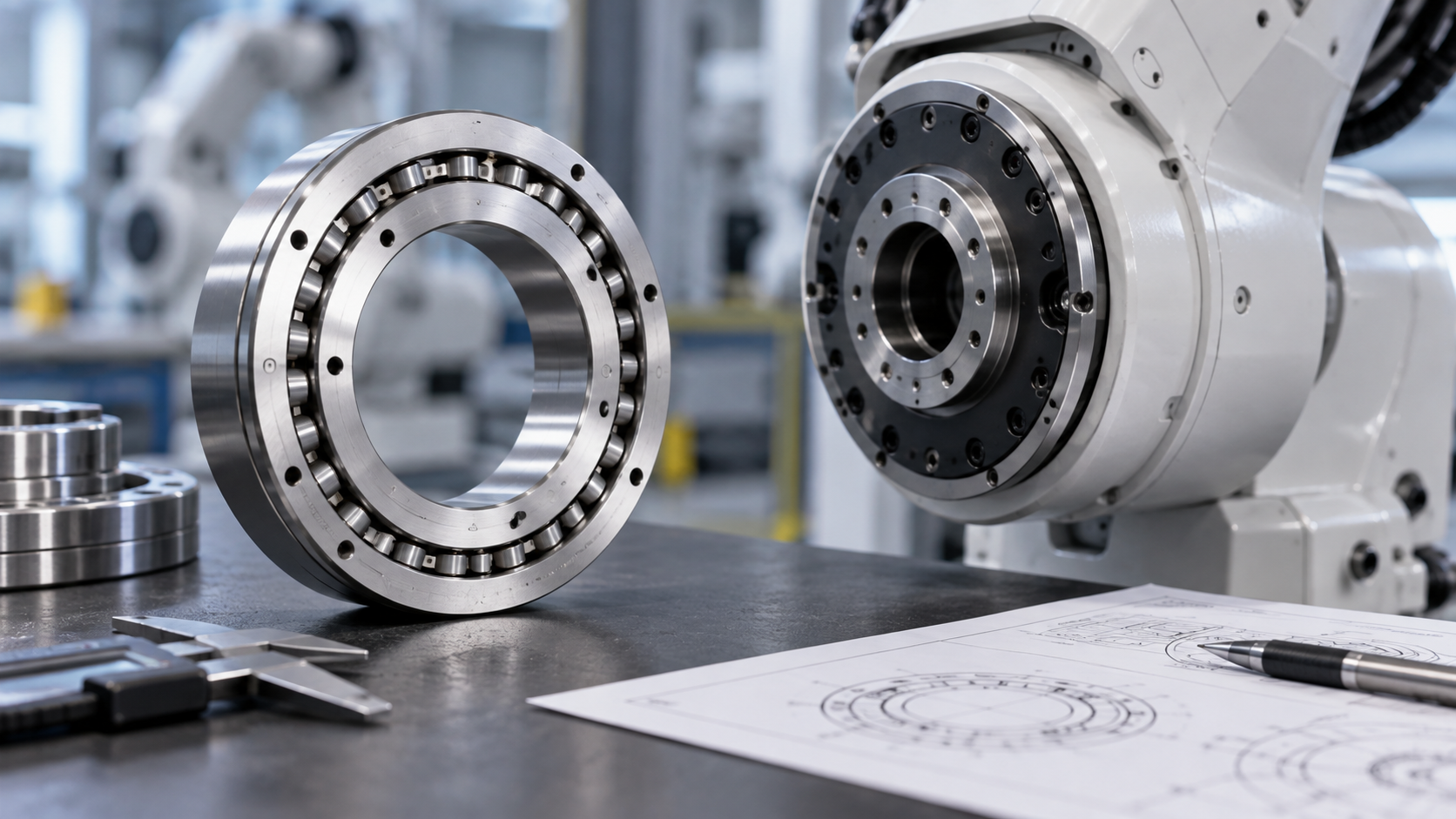
01Where Backlash Comes From in a Robot Joint
Backlash is angular play between the drive input and the joint output. In a bearing, the play comes from four places: internal clearance inside the raceway, a parting line in a split ring, mounting distortion, and wear over time. Each source adds a small angle. Added together, they set the repeatability ceiling of the axis.
| Source of play | How it appears in the joint | Where RAU removes it |
|---|---|---|
| Internal clearance | Rollers lift off the unloaded raceway at reversal and the ring rotates freely through the clearance angle | Factory-set preload before delivery |
| Split-ring joint line | Clamping gap and bolt stretch vary with each assembly, so the play changes every time the ring is fitted | Integrated one-piece inner and outer rings |
| Mounting distortion | Over-sized fits or uneven housing torque distort the raceway and change the running clearance | Controlled by fit specification and bolt torque procedure |
| Wear | Roller and raceway contact surfaces wear, preload relaxes, and play returns slowly | Delayed by correct preload, lubrication, and sealing |
Robot joints spend most of their life reversing direction. Every reversal crosses whatever play exists in the system, so play that a uni-directional spindle could tolerate becomes a daily position error in a robot. The table above is the budget a joint engineer works from: close each row and the axis repeats.
02Internal Clearance Is Play Inside the Raceway
A bearing with positive internal clearance has a small space between the rollers and the raceways. Under load the rollers sit against one side. When the direction reverses, the load path flips and the rollers travel across the clearance gap before they carry load again. During that travel the output ring moves without moving the load. That is lost motion, and it repeats on every single cycle.
In a precision axis the fix is not tighter manufacturing alone. It is preload: the rollers are made to interfere with the raceway by a controlled amount, so every roller stays in contact with both inner and outer raceways at all times. There is no gap left for the ring to travel across. The contact is elastic, but it never opens. Public tolerance standards such as ISO 5753 define internal clearance classes for rolling bearings; a preloaded crossed roller bearing operates outside that clearance range by design, with the interference set at the factory.
03Split Rings Bring a Fitter-Dependent Gap
Crossed roller bearings are built in two families: integrated rings, machined as one piece, and separated rings, where one ring is split so the roller set can be loaded in. The split-ring family needs the fitter to clamp the two halves around the rollers with bolts, and the final preload depends on that clamping job. Bolt torque scatter, gasket thickness, and the feel of the assembly all land inside the finished bearing.
The practical consequence is unit-to-unit scatter. Two joints assembled in the same workshop can measure differently because the clamp load differed. The full comparison of the two architectures is covered in our article on integrated ring versus separated ring crossed roller bearings. The short version: an integrated ring has no joint line, so there is no assembly clearance and no clamping error to manage. RAU series bearings use integrated one-piece inner and outer rings, which is why they mount with repeatable behavior from the first unit.
04Wear Brings the Slow Return of Play
Wear is the last source of backlash, and the only one that grows with operating time. Each roller passes a given raceway point at high frequency, and under boundary or marginal lubrication the contact surfaces slowly polish away. As material leaves the raceways, the preload that held the bearing rigid relaxes. The bearing returns to clearance, and the backlash that factory preload removed comes back.
Two habits delay this. The first is keeping the preload within the design range, because excess preload raises contact stress and accelerates wear while too little preload lets rollers skid. The second is maintaining a correct grease film, since the film separates the metal surfaces in the load zone. A correctly preloaded, correctly lubricated crossed roller bearing loses its rigidity slowly enough that the rest of the robot wears out first.
05Factory Preload Holds Contact That Never Breaks
Factory preload is the difference between a bearing and a structural element. In an RAU bearing the rollers are packed at high density into the V-groove raceway and held by a spacer retainer, then the ring set is assembled with a controlled preload. The bearing ships with that preload set. No field adjustment is needed, because the setting was made on a press with measured deflection, not by feel in a workshop.
Preload does three jobs in a robot joint. It removes backlash, because rollers never leave the raceways. It raises stiffness, because a loaded contact is already in compression when the external load arrives. And it makes the bearing predictable, because every unit leaves the factory with the same internal state. The general mechanics of how preload changes bearing behavior are explained in our guide on crossed roller bearing preload and why it matters.
Consistent preload from the first installation is the phrase that matters to a robot builder. A bearing whose internal state is fixed at the factory removes assembly skill from the accuracy equation. Two technicians, two shifts, two joints: the same result.
06RAU Versus Field-Clamped Rings for Assembly
The difference between factory preload and field clamping shows up in three measurable places: mounting steps, runout consistency, and the skills required. The table compares the two routes side by side.
| Assembly step | RAU integrated ring | Separated ring, field clamped |
|---|---|---|
| Preload setting | Set at factory, delivered with the bearing | Set by clamping torque during assembly |
| Ring structure | One piece, no joint line, no assembly clearance | Parting line that must be closed around the rollers |
| Runout consistency | Same from unit to unit | Depends on each clamping job |
| Backlash after mounting | None added by assembly | Risk of play if the clamp relaxes or distorts |
Split-ring designs exist for a reason: they allow the roller set to be serviced and the bearing to be built around a shaft. When an axis demands the lowest possible backlash and the least assembly sensitivity, the integrated-ring route is the direct answer.
07What a Builder Receives With Each RAU Bearing
Preload is only as good as the inspection behind it. Every RAU bearing ships with dimensional inspection data: bore tolerance, radial runout, and assembly height, verified at four quadrant positions. That four-point check catches ovality that a single measurement would miss, which matters because an oval raceway behaves like a bearing with uneven preload around its circumference.
RAU bearings cover a bore range from 20mm to 350mm with standard precision grades P5, P4, and P2, in a thin rectangular cross-section. A wrist-axis example sits in the same envelope family as RAU 2005 (20mm bore, 31mm outer diameter, 5mm width, basic dynamic load rating 1.49 kN), while a shoulder axis might draw on RAU 15008 (150mm bore, 166mm outer diameter, 8mm width, 8.82 kN). The grade and preload are matched to the accuracy target of the axis, not picked by habit.
08How Backlash Shows Up in Robot Performance
Backlash does not announce itself as a single dramatic failure. It shows up as a family of symptoms: tool-tip overshoot at direction changes, contour error on curved paths, and drift in repeatability tests after the robot warms up. The worse the play, the larger the error, and the harder the controller has to work to compensate for a mechanical angle it cannot measure directly.
Robot joint designers therefore buy stiffness, not just load capacity. A single crossed roller bearing supports radial loads, axial loads in both directions, and overturning moment loads at the same time, and Yuanhe rates the design at three to five times the moment stiffness of an equivalent ball bearing. On articulated arms the payoff is measured in TCP deflection below 0.01mm at full payload. The bearing-level choices that make those numbers possible are the same ones discussed throughout this article: roller line contact, integrated rings, and preload that never relaxes. For a broader view of where these bearings carry robot axes, see our overview of crossed roller bearings for robot joints.
09Frequently Asked Questions
What is crossed roller bearing backlash?
Backlash is the angular play between the raceways and the rollers that appears when the load direction reverses. In a preloaded crossed roller bearing the rollers stay in contact with both raceways, so the ring has no free travel and the backlash is effectively closed at the factory.
Can clamping a split ring match factory preload?
Not repeatably. Factory preload is set with measured deflection on a press, while field clamping depends on bolt torque, part tolerances, and assembly technique. RAU integrated rings avoid the question entirely because there is no split line to clamp.
Does preload increase wear in the bearing?
Preload adds a baseline contact stress that must be accounted for in the life calculation, but the correct preload also stops roller skid and eliminates impact loads from clearance crossing. Both skid and impact are harder on raceways than steady preload. The setting matters: too much preload shortens life, too little lets play return.
Which precision grade do robot joints normally use?
RAU bearings are available in P5, P4, and P2. Robot joints that target repeatability in the hundredths of a millimeter typically work from P4 upward, with the grade matched to the encoder resolution and the accuracy budget of the axis.
How is preload verified when the bearing is delivered?
Through the dimensional inspection data that ships with every bearing. Bore tolerance, radial runout, and assembly height are checked at four quadrant positions, so the delivered part is documented before it is mounted, not after problems appear.
10Key Points Before You Specify
- Backlash in a robot joint comes from internal clearance, split-ring assembly gaps, mounting distortion, and wear. Preload closes the first three; lubrication and sealing slow the fourth.
- Factory preload keeps every roller in contact with both raceways, so direction reversal never crosses a clearance zone.
- Integrated one-piece rings remove the assembly clearance and clamping scatter of separated-ring designs.
- Ask for the inspection data: bore tolerance, radial runout, and assembly height at four quadrant positions.