

 English
 French
 German
How Long Do Ball Bearings Last
EXPECTATION FIRST
How long do ball bearings last? Ask ten maintenance engineers and you get ten different answers, because the question hides a second question. Lasts under what load, at what speed, in what air?
A bearing has no clock inside it. It carries a load rating in the catalog, and everything after that is duty. What follows explains what sets the answer and what shortens it fastest.
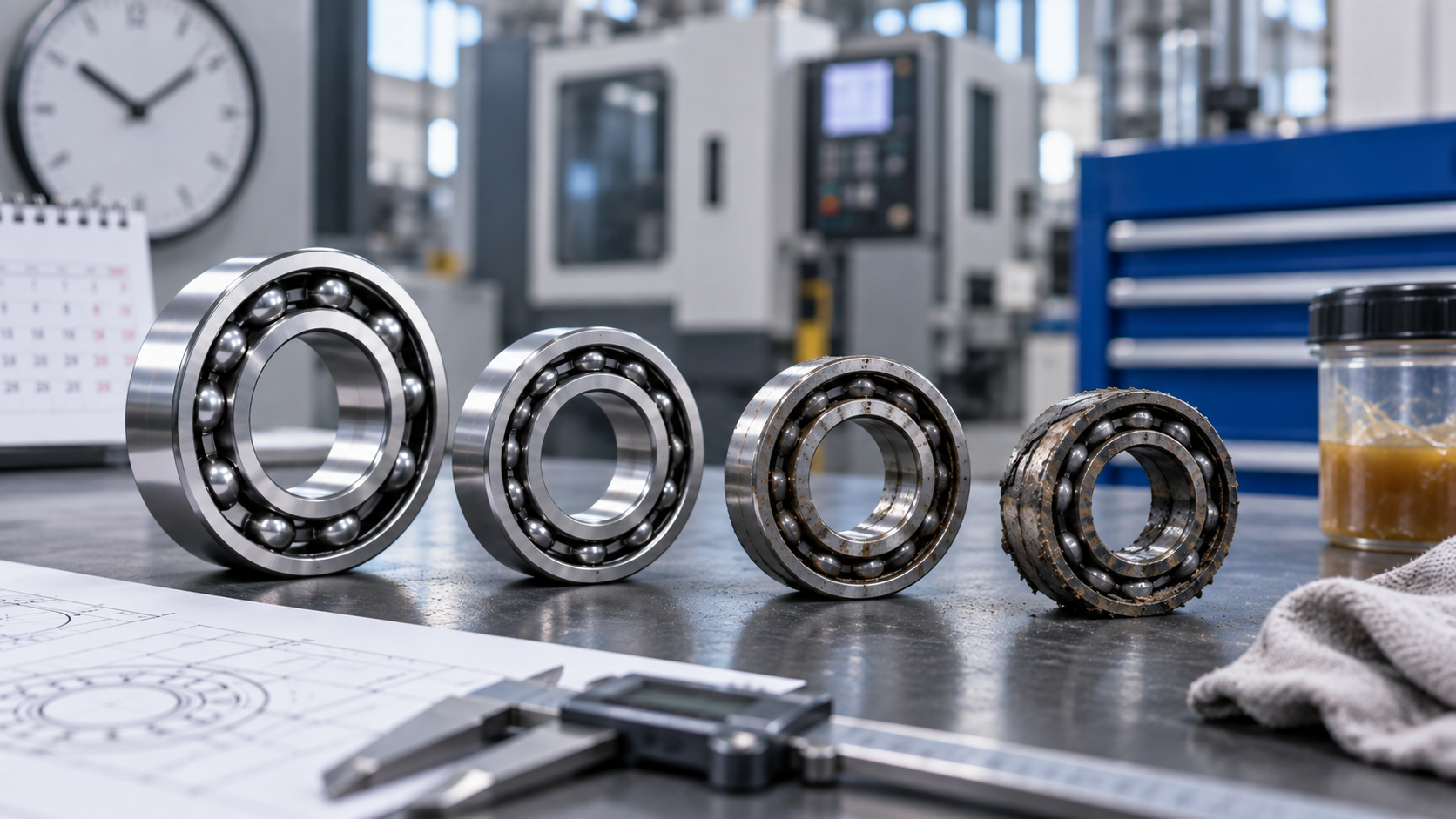
01The Honest Answer
A ball bearing does not carry a countdown timer inside the steel. It carries a load rating, and a duty waiting on your machine. Rating life describes how many revolutions it should complete before fatigue shows in a group of identical bearings.
ISO 281 is the public standard behind that idea, and most catalogs quote the basic dynamic load rating from it. That rating says how far 90 percent of a batch should reach at one steady load and one steady speed. Real machines hold neither steady, so the honest answer is a range, not a date.
Life Is Counted in Revolutions, Not Months
Think in revolutions, or in running hours multiplied by speed. A fast shaft piles on revolutions quickly, and every revolution spends a little of the fatigue budget stored in the raceway.
A bearing that sat in a spare parts cabinet is not worn out, because sitting still spends nothing. Running, by contrast, spends the budget steadily.
Where the Catalog Load Rating Comes From
The dynamic load rating is not pulled from thin air. It comes from tests on groups of bearings, and the standard sets rules for turning those results into one number you can compare across sizes.
When your existing supplier hands you a rating, you are looking at a load, not a lifespan. The lifespan appears only when you fold in your own load and speed.
02The One Rule That Decides Most of It
If you keep one piece of math from this page, keep this one. For a ball bearing, rating life scales with the cube of the load. The exponent is three, and it overwhelms almost everything else in the equation.
Double the load and rating life falls to about one eighth. Halve the load and rating life climbs about eight times. That is why load sits at the top of the ranked list below.
Doubling the Load Brings Eight Times Less Life
Run the numbers in your head. Twice the load, cubed, multiplies the damage rate by eight. Three times the load multiplies it by 27, which is why a bearing that looked oversized can suddenly look too small.
Why Speed Comes Second
Speed enters the equation directly, not as a cube. Double the speed and the bearing works twice as many revolutions in the same running time, so life in running hours about halves.
Load still wins, though. A small percentage change in load moves life far more than the same change in speed.
03What Shortens Life, In Order
The rest of the list is about protecting the raceway surfaces and the film of oil or grease between them. Here are the five items that shorten life most often.
01 Load Above the Rating
A bearing sized for a light fan duty will not enjoy life on a heavily loaded shaft or in a hot spot. When the working load climbs toward or past the dynamic load rating, the cubed relationship from the section above takes over. A modest overload is not a small penalty, it is a large one, and it arrives as subsurface fatigue rather than a sudden crack. Check the real load, including belt tension, gear forces and process shock, before you blame the bearing itself. Measure that load rather than estimating it, because the cube makes a small error expensive.
02 Lubrication Failing or the Wrong Grease
Grease is the film that keeps metal off metal, and it works inside a temperature range, so running outside that range thins the film. The wrong base oil, the wrong thickener, or a fill quantity that is too low all finish the same way, with metal touching metal and the surface smearing. Water entry washes the film away slowly, and a hot machine needs a grease rated for that heat. Our notes on deep groove bearing grease cover fill and range in detail. Too little grease starves the balls, letting metal touch metal.
03 Dirt and Water Getting Past the Seal
Contamination is the quiet one of the group. A few hard particles rolling through the raceway act like a lap, polishing away surface on every pass. Water adds damage by breaking the film and starting corrosion on the steel. Sealed bearings hold up better in dirty air, while shielded bearings trade some protection for lower friction. Grinding dust and process fines are the usual sources, and they often walk in through a housing that was never sealed at the seat, so match the seal to the environment rather than the price column.
04 Mounting and Fits
A perfectly rated bearing will not reach its expected life if it is pressed in crooked or clamped with the wrong fit. Too tight a shaft fit pinches the inner ring and adds preload nobody designed for. Too loose a fit lets the ring creep and wear its seat. Misalignment across the housing stacks extra load on your calculated number, and it is one of the most common findings during a teardown. A press that is not square, or a hammer used as a press, leaves its mark on the raceway.
05 Heat
Heat sits at the bottom because it is often a symptom as much as a cause, yet it feeds the problem. Higher temperature shortens grease life, thins the oil film and softens the steel a little at the same time. Poor airflow, an overfilled housing and a shaft running out of alignment are heat sources you can fix without touching the bearing. One hot spot is a clue rather than a coincidence, and fixing airflow or alignment often buys more running time than a larger bearing does. Start with the cheap fixes.
04How Long in Common Machines
| Machine | What sets life there |
|---|---|
| Electric motor on a pump | Runs to the grease service interval. |
| Conveyor drive roller | Dust and misalignment shorten life before load does. |
| Gearbox input shaft | Gear forces and oil condition decide it. |
| Fan and blower | Heat and belt tension move it most. |
| Indexing table or robot joint | Rigidity and contamination dominate, so a crossed roller bearing often fits better. |
What the Table Is Telling You
In every row the limiting item is the weakest link in that duty, not the bearing alone. Two machines with identical bearings can sit at opposite ends of the answer.
On a special machine, custom manufacturing can match the bearing and grease to the duty.
05Signs You Are Near the End
What You Hear and Feel
New roughness in the sound, a rising vibration reading, or a spot running warmer than its twin are early notices. Later you feel play at the shaft. Our guide to ball bearing noise diagnosis explains what each sound points to.
What You See in the Grease
Dark grease, a metallic sheen, or grease pushing past the seal show that the film is no longer doing its job. A polished raceway tells the same story on the bench.
A QUICK CHECK
Send us three things, the running speed, the load on the shaft, and the machine type. We will recommend a bearing and grease for that duty, so the next replacement is planned. Send your duty details here.
06Replacing Late Costs More Than Replacing Early
A bearing that fails on its own schedule takes the machine with it and writes the repair order for you. One changed inside a planned window costs a part and a short stop, and the gap between those two events is where the money hides.
Spares on the Shelf, Windows on the Calendar
Keep the right spare on the shelf and lead time stops mattering at the worst moment. Watch the temperature and vibration trend, then change the bearing on your terms.
07Questions We Hear Most
SIZE THE DUTY CYCLE
Tell us the load, the speed and the machine, and we will match the bearing and grease to the duty. Yuanhe builds deep groove ball bearings and crossed roller bearings, with samples before production tooling.