

 English
 French
 German
Custom Crossed Roller Bearings. What Robot OEMs Specify
Custom crossed roller bearings for robot OEMs start as a drawing. A catalog RAU bearing covers the standard envelope, but a production robot is built around proprietary joints, and the joint geometry decides where the bearing bore, outer diameter, and width must land. So the OEM sends a drawing, and the bearing maker builds to it. The quality of that exchange decides whether the joint meets its accuracy target on the first prototype or on the fifth.
This article walks through a robot OEM bearing specification the way an applications engineer reads it, field by field. Yuanhe manufactures crossed roller bearings under ISO 9001:2015 certified processes, with 12,000+ OEM projects behind the drawing review, and the RAU series is the base architecture for most custom work: integrated one-piece rings, spacer retainer, and factory-set preload.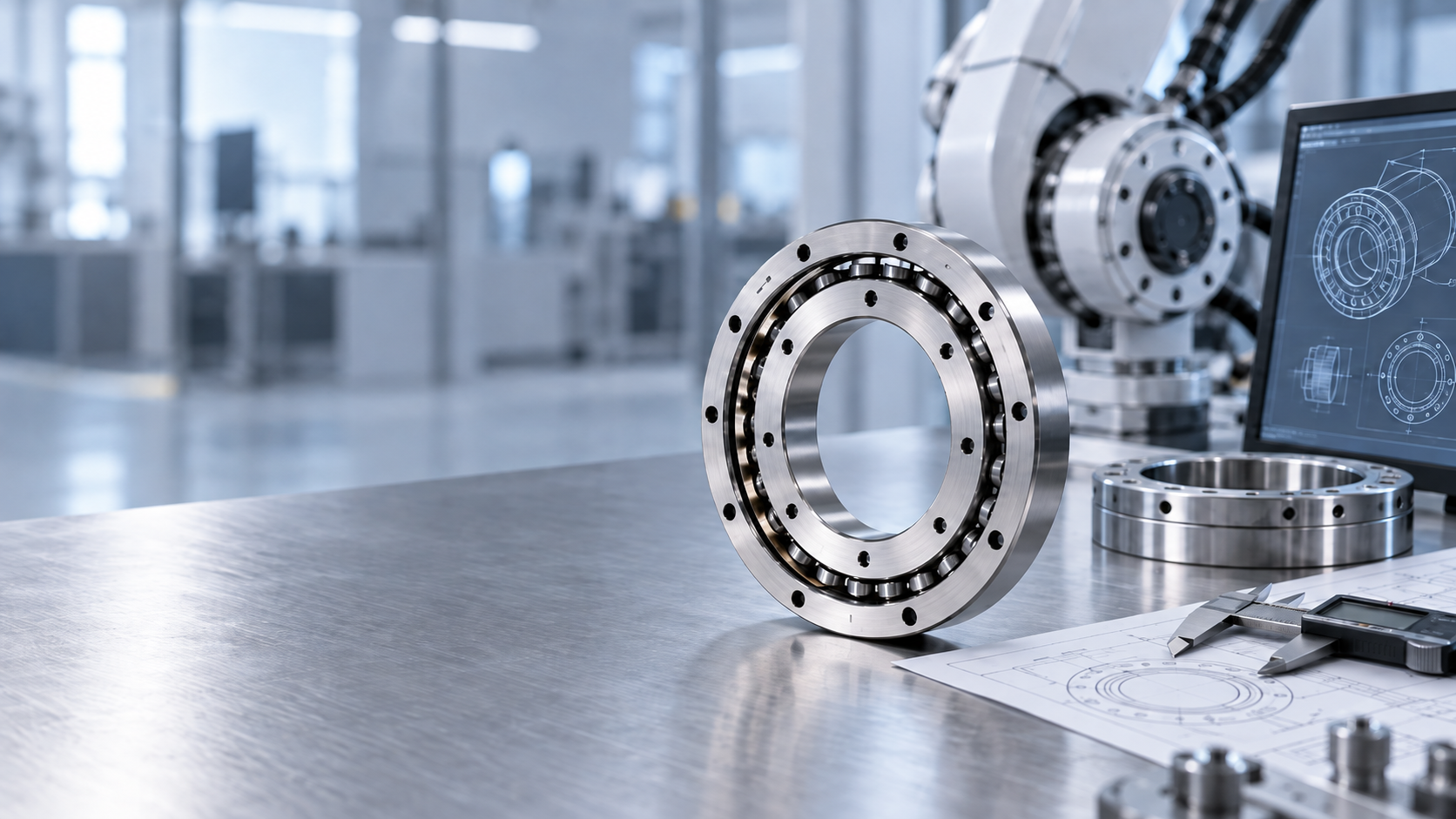
01The Drawing Is the Contract
A custom bearing order is an agreement about numbers: dimensions, tolerances, load ratings, and inspection criteria. Vague drawings produce bearings that are technically to print and functionally wrong. OEMs who specify well share one habit: they write down the operating conditions on the drawing or in a companion document, so the maker can check the bearing against the load case instead of guessing at it.
The fields below are the ones that matter for a robot joint bearing. Some come straight from the RAU catalog; others are custom by definition. The mock spec sheet in the next section shows a complete set, and the sections after it explain what each field means and where OEMs make mistakes.
02An OEM Bearing Spec Sheet, Field by Field
| Spec field | What the OEM writes | Why it matters |
|---|---|---|
| Envelope | Bore, outer diameter, width with tolerances | Locks the bearing into the joint housing geometry |
| Mounting details | Corner radius, shoulder limits, lubrication holes | Prevents interference with the housing and shaft steps |
| Precision grade | P5, P4, or P2 | Sets the runout and tolerance class of the axis |
| Preload | Preload class or running-torque target | Determines stiffness and backlash behavior in the joint |
| Seal form | Sealed, shielded, or open; seal material if special | Matches contamination and cleaning conditions |
| Material | GCr15 bearing steel or stainless grade | Sets hardness, corrosion resistance, and cost |
| Lubricant | Grease type, NLGI grade, temperature range | Governs torque, film life, and operating window |
| Inspection and samples | Dimensional report, material certification, first-article samples | Proves the delivered bearing matches the agreed numbers |
03Envelope and Mounting Details
The envelope is where custom crosses the catalog. Standard RAU series crossed roller bearings run from 20mm to 350mm bore in a thin rectangular cross-section, with width bands of 5mm, 8mm, and 13mm across the range. A robot OEM commonly needs a bore or width between those catalog points, or a flange pattern that the standard part does not carry. That is the point of a custom bearing: the roller complement and raceway stay RAU architecture, while the envelope follows the housing.
Mounting details deserve the same precision as the bore. The RAU catalog lists corner radius limits and shoulder dimensions for every size, because a housing step that touches the bearing corner acts as a stress raiser on a thin-section ring. OEM drawings that omit corner radii force the maker to guess, and guessing produces interference or a loose fit. The standard table fields, lubrication hole and corner radius included, are there to be reused, not rediscovered.
04Precision Grade P5, P4, or P2
The precision grade is the tolerance class of the finished bearing, and it should be derived from the accuracy budget of the axis, not from habit. RAU bearings are available in P5, P4, and P2. A wrist joint that must hold tool-tip repeatability in the hundredths of a millimeter works from P4 or P2, while a P5 part may satisfy a lower-cost axis with encoder compensation.
The grade also interacts with preload. A higher grade tightens the geometric errors, which lets the factory preload act uniformly around the circumference. The same preload on a looser-grade ring distributes unevenly. For the working meaning of each grade, our article on crossed roller bearing accuracy grades and what P5, P4, and P2 mean walks through the selection logic in detail.
05Preload and Running Torque
Preload is the least visible line on a spec sheet and the one with the largest effect on joint feel. In the RAU design the preload is set at the factory with measured deflection, and it arrives in the bearing rather than being created during assembly. A custom specification should therefore state the preload class or, better, a running-torque target measured at a defined speed and temperature, because torque is what the servo actually feels.
Two OEM habits cause most preload-related rework. The first is specifying preload without a measurement method, which leaves acceptance open to dispute. The second is ignoring temperature: grease viscosity and ring expansion both change running torque, so the target has to name its test conditions. A one-line note, for example stating the torque band at 20 degrees Celsius and a defined speed, turns a vague requirement into an accept-reject criterion.
06Material Choice GCr15 or Stainless
Standard RAU bearings run on GCr15 bearing steel, through-hardened to HRC 60-64, which is the same material family as AISI 52100. GCr15 is the default for robot joints in dry, indoor environments because it combines hardness, fatigue resistance, and dimensional stability at a sensible cost.
Stainless steel enters the specification when the joint must survive corrosive exposure: washdown residue, marine air, or aggressive cleaning chemistry. A stainless raceway trades a little hardness for corrosion resistance, and the roller complement changes with it. OEMs in food-adjacent or chemical plants should state the corrosive agent, not just write stainless, so the grade can be matched to the actual exposure.
07Lubricant, Sealing, and Interface Details
Lubricant specification is a torque decision as much as a wear decision. The grease type and NLGI grade set the baseline running torque, and the temperature range on the spec sheet should bracket the worst case the joint sees, not the average. Robot OEMs who skip this field receive a standard grease that may be right or may add measurable drag at cold start.
Sealing is specified against the environment, and the RAU architecture supports the decision: integrated one-piece rings leave no parting line for contamination to enter, which is one reason the design suits sealed joints. For applications that need the full reasoning on ring architecture, see our comparison of integrated ring versus separated ring crossed roller bearings. Seal form, grease charge, and any special interface features are where a custom drawing earns its keep.
08Inspection Reports and Sample Validation
The spec sheet closes with evidence. Every Yuanhe crossed roller bearing, standard or custom, ships with dimensional inspection data: bore tolerance, radial runout, and assembly height, verified at four quadrant positions. For a custom part the OEM should also ask for material certification and, on the first lot, a first-article inspection against the drawing before full production runs.
Sample validation is where custom bearings prove themselves. The sequence that works in practice: review the drawing with the maker, build a small first-article batch, measure the samples against the spec sheet, mount them in real joint housings, and test torque, runout, and backlash on the actual assembly. Only then does the design freeze. This is the loop behind 12,000+ OEM projects: drawing review, first article, measurement, release.
09Frequently Asked Questions
What is the difference between a custom and a standard RAU bearing?
A standard RAU bearing uses the catalog envelope, with bores from 20mm to 350mm and width bands of 5mm, 8mm, and 13mm. A custom bearing keeps the same roller and ring architecture but follows the OEM drawing for envelope, mounting features, seal form, grease, and material.
Which precision grade should a robot OEM specify?
Match the grade to the axis accuracy budget: P5 for cost-driven axes with encoder compensation, P4 or P2 for joints that must hold repeatability without relying on the control loop.
Do custom bearings change the delivery inspection?
No. Every bearing ships with dimensional inspection data, and custom parts add first-article inspection and material certification against the drawing before production quantities are released.
What should the drawing include besides the dimensions?
Operating conditions: load direction and magnitude, speed or cycle rate, temperature range, contamination exposure, and the accuracy target. Those conditions let the maker check the bearing against the real load case instead of the nominal one.
10Key Points Before You Send the Drawing
- Write the operating conditions next to the dimensions; the load case is half the specification.
- Derive the precision grade from the axis accuracy budget, and state the preload as a torque band with test conditions.
- Name the corrosive exposure before writing stainless, and the temperature range before writing a grease.
- Validate with a first-article batch measured against the spec sheet before the design freezes.