

 English
 French
 German
Crossed Roller Bearings in Aerospace and Defense Systems
Crossed roller bearings aerospace applications place demands on bearings that go far beyond industrial specifications. The bearing must survive launch vibration levels that would destroy an industrial bearing within seconds, operate reliably in the vacuum of space without outgassing or cold-welding, hold micron-level alignment through thermal swings of 100 degrees Celsius or more between sunlight and shadow, and in many cases never receive maintenance or relubrication after the spacecraft leaves the ground. Crossed roller bearings meet these extreme demands within a compact, lightweight form factor that saves grams of mass on platforms where every kilogram launched to orbit costs thousands of dollars.
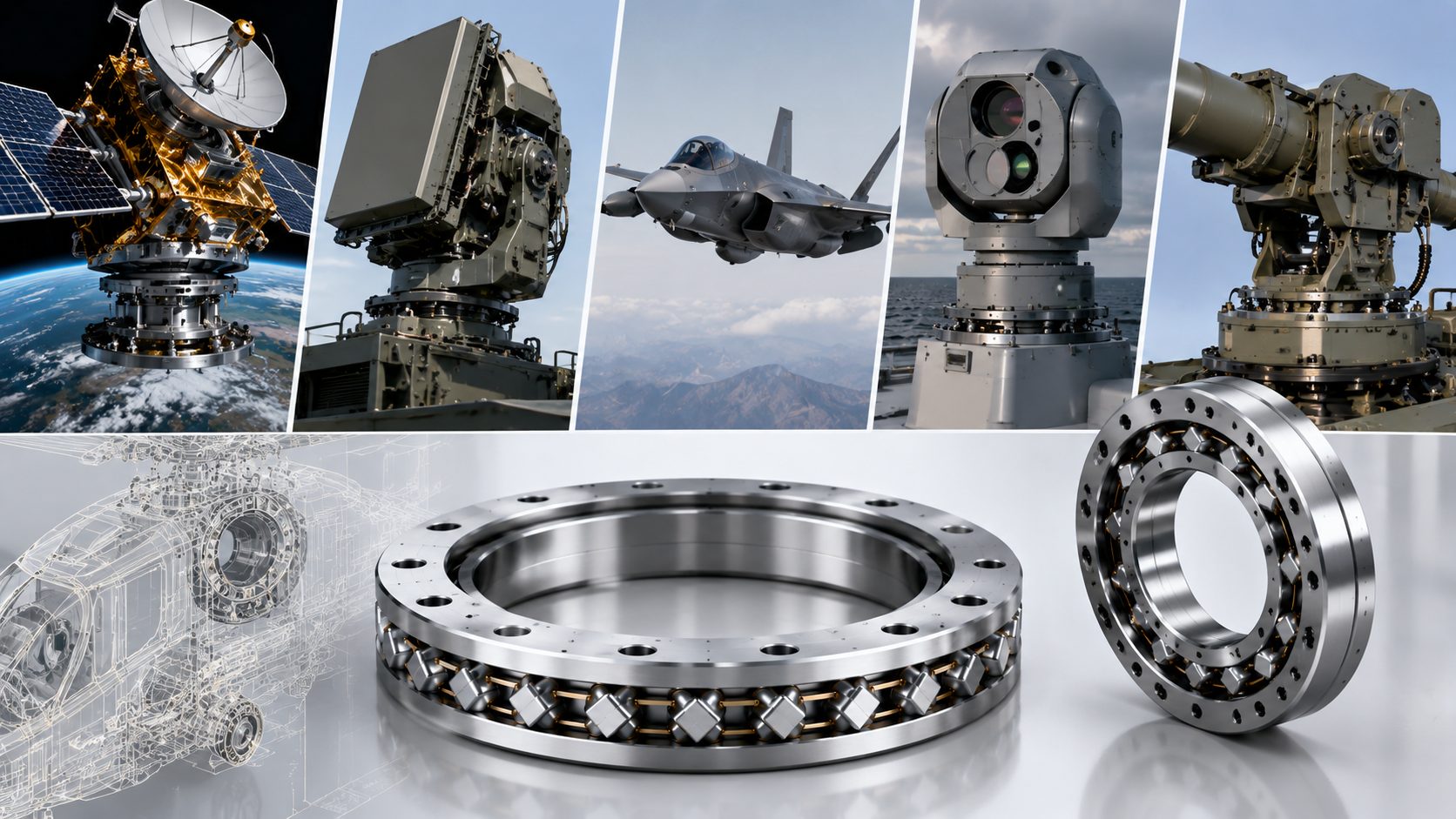
Three distinct aerospace applications illustrate the range of crossed roller bearing capabilities: satellite reaction wheel assemblies that spin continuously for a decade or more to control spacecraft attitude, ground-based radar antenna pedestals that must track targets smoothly in all weather conditions, and airborne optical targeting gimbals that operate from minus 40 degrees Celsius at altitude to plus 70 degrees Celsius on the runway. Each application pushes a different performance boundary to its limits.
THERMAL SWING10+ YRS
MISSION LIFE3
APPLICATION PROFILES100%
LOT TRACEABILITY
01Satellite Reaction Wheel Assemblies
A reaction wheel is a precision flywheel spun by a brushless DC motor to control satellite orientation through conservation of angular momentum. Speed up the wheel and the satellite rotates slowly in the opposite direction. Slow the wheel down and the satellite rotates back. A typical satellite carries three or four reaction wheels arranged orthogonally to provide three-axis attitude control. The bearing supporting each wheel rotor spins continuously at speeds ranging from several thousand RPM for smaller, high-speed designs, and it does so for the entire operational life of the satellite, which may extend to well over a decade.
DESIGN NOTE
Solid Lubrication in Hard Vacuum
The bearing operates in hard vacuum. Standard bearing grease would outgas within hours of reaching orbit, and the volatile compounds would condense on optical surfaces, thermal radiators, and solar arrays, degrading their performance. Reaction wheel bearings use solid lubricant instead — a thin film of lead, gold, or molybdenum disulfide deposited on the raceway and roller surfaces through physical vapor deposition or sputtering. During the first few hours of operation on orbit, the film transfers between the contacting surfaces, establishing a self-replenishing tribofilm that provides lubrication for the life of the mission without any liquid or grease component.
CRITICAL LOAD
Launch Vibration — The Most Demanding Load Case
During the eight to ten minutes of powered ascent, the bearing experiences random vibration across a broad frequency spectrum at high amplitude. The bearing preload must be set high enough that the rollers never lose contact with the raceway surfaces at the peak vibration amplitude, because any momentary loss of contact allows the rollers to impact the raceway on the next vibration cycle, causing brinelling damage that shortens the bearing’s orbital life. This vibration g-load capability is specified and tested separately from the standard load ratings.
Reaction wheel bearings also face a unique cage stability challenge at the zero-crossing speed when the wheel changes direction. At very low speeds near zero RPM, the cage that separates the rollers can become unstable and oscillate, generating noise and potentially damaging the cage pockets. Bearing designs for reaction wheels use specialized cage geometries, sometimes with guided outer-ring land riding surfaces, to maintain cage stability through all operating speeds including the direction-reversal transient.
02Radar Antenna Pedestal Bearings
Ground-based radar antennas range from small units mounted on mobile platforms to building-sized phased arrays for ballistic missile defense. The pedestal bearing supports the entire antenna mass while allowing smooth rotation in azimuth and precise tilting in elevation. The bearing must position the antenna within a fraction of a degree so the radar beam points exactly where the control system commands, and it must do so in wind, rain, ice, and temperature extremes.
DOMINANT LOAD
Wind-Induced Overturning Moment
A radar antenna is a large flat structure that catches wind the way a sail does. In storm conditions, the overturning moment from wind loading at the base of the pedestal can substantially exceed the static moment from the antenna weight. The crossed roller bearing at the pedestal base resists this combined loading efficiently because the orthogonal roller arrangement provides high moment capacity relative to the bearing diameter, and line contact distributes the load over a larger contact area than a ball bearing of similar size.
Tracking smoothness is a second performance requirement. When a radar tracks a moving aircraft or missile, the antenna rotates at a slow, steady angular rate. Friction variation in the pedestal bearing, known as stick-slip, causes the antenna to move in small jerks rather than a smooth continuous sweep. This jitter broadens the radar return signal and reduces the accuracy of the position measurement. Crossed roller bearings avoid stick-slip because the rolling motion is pure rolling at the design contact point with no sliding component, enabling the servo drive to maintain smooth tracking without a high-bandwidth control loop to compensate for friction irregularities.
03Airborne Optical Targeting Gimbals
An airborne targeting pod hangs under the wing of a fighter aircraft or beneath the fuselage of a surveillance drone. It points high-resolution cameras and laser designators at targets on the ground while the aircraft maneuvers. The gimbal that steers the optical payload uses crossed roller bearings on two orthogonal axes. These bearings operate in an environment that cycles through the full extremes of aviation: extreme cold at altitude and extreme heat on a sun-soaked desert runway, continuous broadband vibration from the engines and aerodynamic buffet, and shock loads from carrier landings or hard runway touchdowns.
THERMAL CHALLENGE
Preload Stability Across the Temperature Envelope
Differential thermal expansion between the aluminum gimbal housing and the steel bearing races continuously changes the effective bearing preload. At extreme cold, the aluminum housing shrinks more than the steel bearing, opening internal clearance and reducing stiffness. At extreme heat, the housing expands and increases preload, raising torque and potentially binding. The design accommodates this range through material selection, preload calculation across the full temperature envelope, and sometimes materials with matched thermal expansion coefficients.
The gimbal bearing duty cycle is also unusual. The pod may sit in storage or fly for hours on a ferry mission with no gimbal rotation, then execute intense slewing maneuvers during a few minutes of target engagement. The grease must not separate into oil and thickener during the dormant periods — a failure mode called oil bleed that leaves the raceway starved of lubricant when movement resumes — and the seals must not take a permanent compression set from sitting stationary in one position for months. Aerospace-qualified greases address these concerns with base oils that resist separation and thickeners that maintain consistency across the full operating temperature range.
APPApplication Comparison
| Characteristic | Reaction Wheel | Radar Pedestal | Optical Gimbal |
|---|---|---|---|
| Environment | Hard vacuum, orbit | Wind, rain, ice, temp extremes | Altitude cold to desert heat + shock |
| Dominant Load | Launch vibration + continuous spin | Wind-induced overturning moment | Thermal cycling + maneuver shock |
| Critical Requirement | Solid lubrication, cage stability | Smooth tracking (no stick-slip) | Pointing accuracy across thermal range |
| Lubrication | Solid film (lead / gold / MoS₂) | Standard bearing lubrication | Aerospace grease (no oil bleed) |
04Materials, Traceability, and Qualification
Aerospace bearings carry full material traceability from the steel mill to the finished bearing. The heat number, forging lot, and every inspection record follow the bearing through its entire service life. This traceability matters because if a bearing anomaly is found during pre-launch testing or if a bearing fails on orbit, the investigation must trace the anomaly back to a specific material batch and manufacturing lot. Every bearing from that lot can then be inspected or replaced before launch, preventing a fleet-wide problem from a single bad batch of material.
MATERIALS
Stainless Steel Races + Weight Optimization
Stainless steel races — typically AISI 440C martensitic stainless steel or nitrogen-enriched variants — prevent corrosion during storage and between missions while offering hardness comparable to through-hardened bearing steels. Rollers use the same material as the races to match thermal expansion coefficients. For weight-sensitive spacecraft applications, the cross-section can be optimized through finite element analysis, removing material from low-stress regions — every gram eliminated is a gram available for additional custom payload capability.
Related: Crossed Roller Bearings, full material cert | Aerospace Custom Bearings
Get a Quote
Yuanhe supplies crossed roller bearings with full material certification and lot traceability for aerospace and defense programs. Contact our engineering team to discuss your performance specification and qualification requirements.