


 English
 French
 German
Crossed Roller Bearing Maintenance and Lubrication Guide
Maintenance Brief
Crossed roller bearings in production equipment run for years between replacements when maintained correctly. When they fail early, the root cause traces back to one of three things in most cases: contaminated lubricant, insufficient relubrication, or mounting bolts that worked loose over time. All three are preventable with a maintenance routine that takes about fifteen minutes per bearing per quarter. The cost of that fifteen minutes is a fraction of the cost of unplanned downtime.
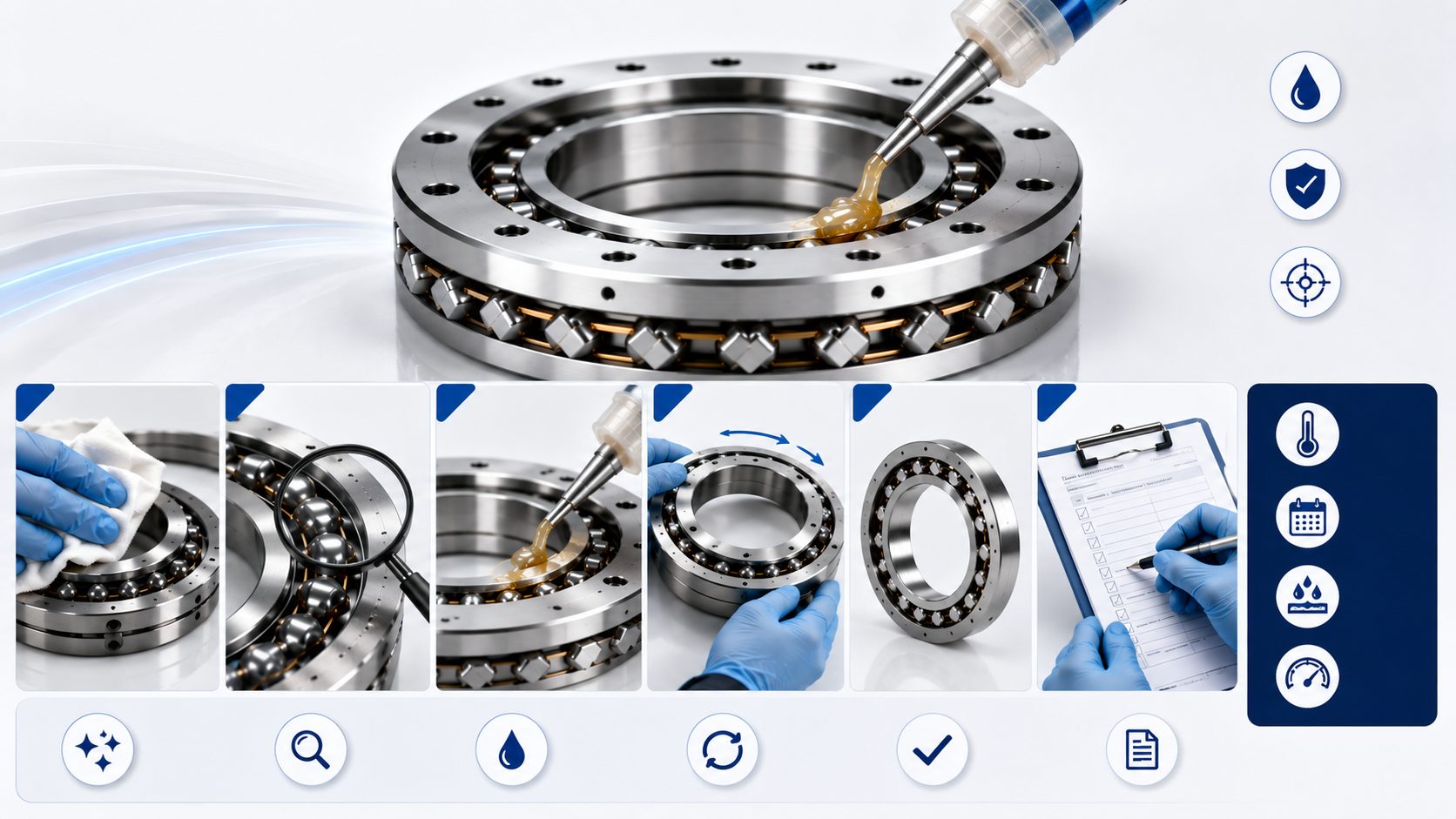
Proper crossed roller bearing lubrication extends service life and prevents premature failures. This guide covers the practical maintenance steps that a machine operator or maintenance technician can perform without specialized bearing knowledge. It covers grease selection, relubrication intervals, seal inspection, and the early warning signs that tell you a bearing needs attention before it fails catastrophically. The recommendations apply to crossed roller bearings in machine tools, automation equipment, and general industrial machinery operating in typical factory environments.
Lubrication Fundamentals
Crossed roller bearing lubrication relies on grease in most industrial applications. The grease does two jobs simultaneously: it maintains an oil film between each roller and the raceway to prevent metal-to-metal contact, and it acts as a physical seal at the bearing edges to block particle ingress. A bearing that runs without adequate grease for even a few minutes can spall the raceway surface, and at that point the bearing is beyond recovery.
Important
Do not mix grease types. Different thickener chemistries are often incompatible. Mixing a lithium soap grease with a polyurea grease can cause the mixture to soften, harden, or separate into oil and thickener phases. If switching grease types, purge the bearing completely with the new grease while warm, rotate it several times, and purge again. Mark the bearing housing with the new grease type.
Lithium soap greases with a mineral base oil work well for general machine tool applications at moderate speeds and temperatures. NLGI grade 2 consistency is the standard choice because it stays in place without excessive churning torque. For higher-speed applications above roughly 500 RPM or elevated operating temperatures, switch to a synthetic base oil such as polyalphaolefin or ester with a lithium complex or polyurea thickener. Synthetic greases resist oxidation better at elevated temperatures and maintain oil film thickness longer than mineral-oil greases under the same conditions.
The grease fill quantity matters more than most people realize. Overfilling a crossed roller bearing raises running torque and operating temperature because the rollers must churn through excess grease on every pass. A fill of 25 to 35 percent of the free internal volume is the standard recommendation. The bearing manufacturer provides the free volume in the catalog or on the drawing. Weigh the grease charge on a gram scale rather than estimating by feel. A bearing that calls for 2 grams of grease will run noticeably hotter with 4 grams, and the temperature increase may be enough to shorten grease life and force more frequent relubrication.
Grease Selection at a Glance
Standard choice — Lithium soap grease, NLGI Grade 2, mineral base oil. For moderate speeds and temperatures.
High performance — Synthetic grease, PAO or ester base, lithium complex or polyurea thickener. For high speed or elevated temperatures.
Fill target — 25 to 35 percent of free internal volume. Weigh on a gram scale. Overfilling raises torque and temperature.
Relubrication Intervals and Methods
There is no universal relubrication interval that works for all applications. The interval depends on speed, temperature, load, and contamination level. As a starting point, inspect grease condition on a regular schedule. Remove a small sample from the bearing cavity using a clean spatula. If the grease appears darkened, dried out, or contains visible particles, reduce the interval. If the grease looks clean and consistent at 500 hours, extend the interval to 1,000 hours and recheck.
Bearings running in clean environments at low speeds may only need relubrication infrequently. Bearings in dirty environments may need fresh grease frequently. The contamination level is usually the dominant factor. If you can see dust accumulating on external surfaces of the machine within a meter of the bearing, those same particles are finding their way into the grease.
Purge-and-Replace Procedure
1Pump fresh grease into the inlet fitting while the old grease exits through the outlet port or relief plug.
2Continue pumping until clean grease of the new color appears at the outlet. This purge method carries contaminants out rather than mixing them into the fresh charge.
3Run the bearing through several slow rotations to distribute fresh grease evenly across the raceway circumference.
4Let the bearing sit for a few minutes to allow excess grease to settle. Wipe away any grease that has emerged from the seals.
Seal Inspection and Replacement
The seals on a crossed roller bearing are the first line of defense against contamination. A torn, hardened, or chemically swollen seal allows particles into the raceway and lets grease leak out. Inspect seals during every lubrication cycle. Look for cracks radiating from the seal lip, tears from installation damage, swelling from exposure to incompatible chemicals, or permanent set that leaves a visible gap between the seal lip and the rotating ring. Run a finger around the seal perimeter. If you feel a rough edge or a gap, the seal should be replaced.
Seal Material Comparison
Nitrile Rubber (NBR) — Good abrasion resistance. Compatible with most mineral oils and greases. Temperature range up to about 100°C. Standard choice for general industrial environments.
Fluoroelastomer (FKM) — Higher temperature resistance. Better chemical compatibility with aggressive cutting fluids and solvents. Check bearing part number suffix for material code.
Field Replacement Tip
Use a plastic or brass pick tool rather than a steel pick to avoid scratching the seal groove. A scratch in the groove becomes a leak path. Press the new seal in evenly using a flat tool matched to the seal outer diameter. Press only on the outer edge, never on the center. A seal pressed in crooked will leak immediately and may contact the rotating ring.
Early Warning Signs
Three signals precede most crossed roller bearing failures by days or weeks. When you observe any of these signs, schedule a bearing inspection during the next planned downtime rather than waiting for the bearing to fail in service.
Three Warning Signals
1Torque increase — Stiffer rotation or uneven torque signals lubricant breakdown or raceway surface damage.
2Audible noise — Clicking, rumbling, or scraping indicates damaged rollers, spalled raceways, or contamination.
3Runout drift — Increasing runout measured with a dial indicator suggests wear or brinelling of the raceway.
Escalation Risk
A bearing caught early can often be cleaned, relubricated, and returned to service if the damage is superficial. A bearing that runs to catastrophic failure may seize, crack, or shed metal particles into the grease, damaging the housing bore, the shaft, and adjacent bearings or gears. The cost escalates from a bearing replacement to a multi-component rebuild.
Related: Crossed Roller Bearings with lubrication specifications included | Custom Manufacturing | Deep Groove Ball Bearings
Get a Quote
Yuanhe provides lubrication specifications and maintenance documentation with every crossed roller bearing shipment. Contact us for relubrication quantity and interval recommendations for your specific operating conditions.