


 English
 French
 German
What Is the Function of a Crossed Roller Bearing
The function of a crossed roller bearing is to carry a heavy load and hold a precise position at the same time. A single bearing takes radial load, axial load, and tilting moment from any direction, then keeps the shaft or table exactly where it should be. That combination is why these bearings show up in robot joints, rotary tables, and medical scanners rather than in ordinary fan motors. This guide explains each part of that function and what it means when you specify one.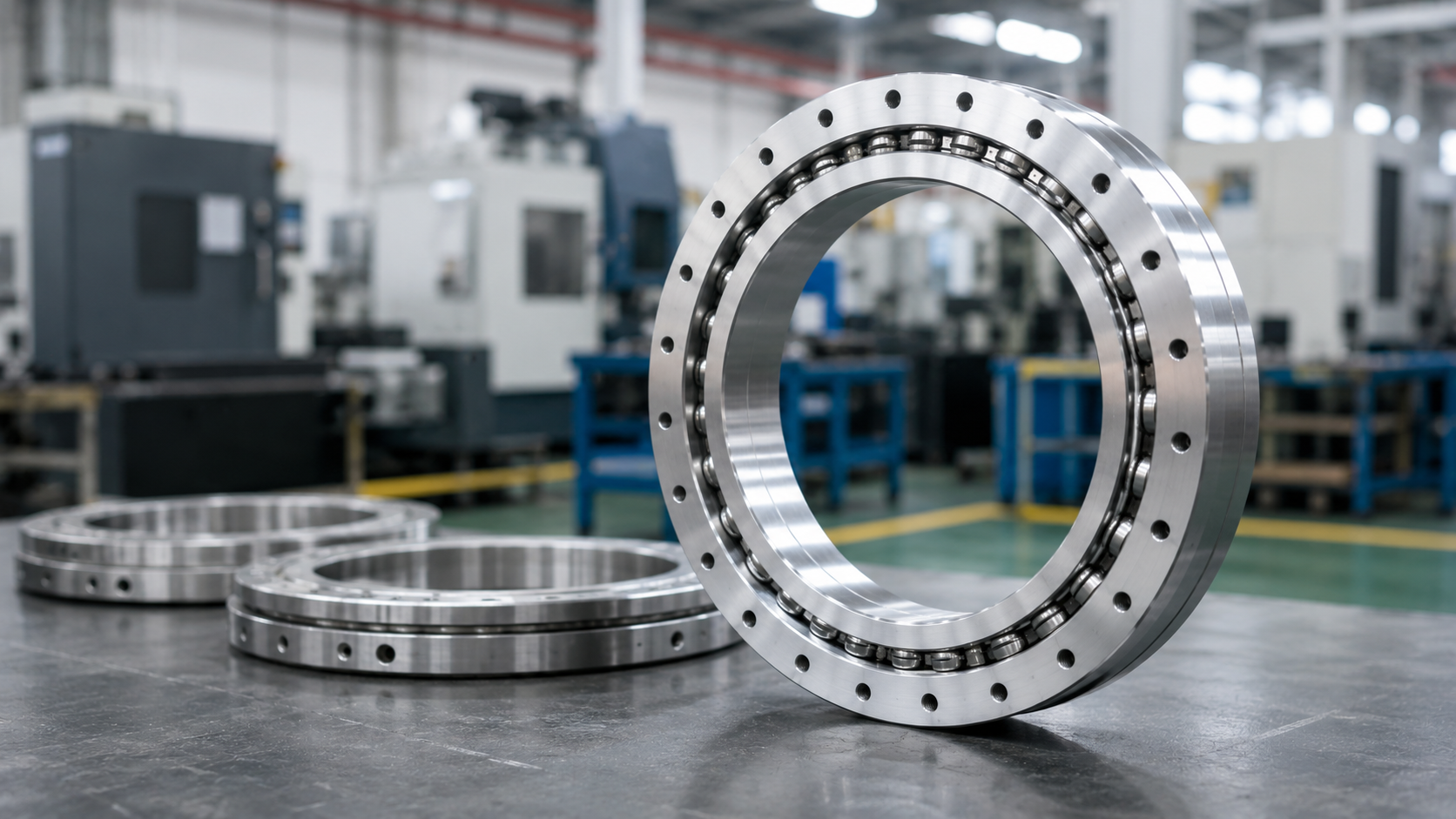
1The Core Function. Load in Every Direction
Most bearings are specialists. A deep groove ball bearing handles radial load well and only a little axial load. A thrust bearing takes axial load and almost no radial load. A crossed roller bearing is a generalist. It handles all three load directions at once, which is the core of its function.
Radial load pushes across the shaft, the way the weight of a rotating table presses down. Axial load pushes along the shaft, the way a thrust force tries to move the assembly lengthwise. A tilting moment tries to tip the assembly over, the way a robot arm leaning out from its base applies a twisting force to the joint. A crossed roller bearing resists all three in one compact ring.
The bearing does this with rollers set at right angles to each other. One roller runs against the inner ring and outer ring in one direction. The next roller runs ninety degrees from it. This crisscross pattern lets each roller carry load on a different axis, so the bearing spreads the work across its full width instead of concentrating it on a few points.
2Why Stiffness Matters
Stiffness is how little the bearing deflects under load. A robot arm lifting a part at the end of a long reach puts a big tilting moment on its joint. If the joint bearing flexes, the tool tip wanders and the part lands out of position. A crossed roller bearing resists that flex because the rollers contact the raceways across a broad line, not a single point.
Line contact is the technical difference between rollers and balls. A ball bearing touches its races at small contact points. A roller bearing touches along a line. More contact area means the load spreads wider, so the same force produces less deflection. That is the stiffness an engineer is buying when they choose crossed rollers over balls.
Stiffness also feeds directly into accuracy. A bearing that flexes under load cannot hold a position. When the load changes mid-move, a stiff bearing stays put while a soft one shifts. For a machine tool cutting a part, that shift is the difference between a good cut and a scrap part.
3Positioning Accuracy
The second half of the function is accuracy. A rotary table on a machining center indexes a part to an exact angle, then a tool cuts it. If the bearing has play, the table wobbles a few microns and the cut is off. Crossed roller bearings are built to tight tolerances so the table rotates true every time.
Accuracy grades tell you how tight. The grades run from P5 down to P4 and P2, where a lower number means tighter runout and better rotational accuracy. Most general motion uses P5. Precision stages and metrology equipment step up to P4 or P2. The accuracy grade is the spec that ties the bearing to its job.
Accuracy does not come from the grade alone. The preload matters too. Factory-set preload removes the internal clearance that would otherwise let the rings shift under load. A preloaded bearing holds its position even as the load direction changes. That is why the preload setting is part of the accuracy story.
4Compact Design That Saves Space
One crossed roller bearing often replaces two bearings. A design that needed a radial bearing plus a thrust bearing can sometimes use a single crossed roller unit instead. The bore stays large relative to the outside diameter, which leaves room for wiring, shafts, and hoses to pass through the center.
That saved space matters in tight places. A robot joint, a CT scanner gantry, or a telescope mount does not have room to stack bearings. A thin, stiff crossed roller bearing fits the envelope and still does the full job. Less axial length also means a shorter load path, which usually means a stiffer assembly overall.
5Where This Function Is Used
The load capacity, stiffness, and accuracy combine in a short list of applications. Robot arms use crossed roller bearings in the joints that rotate and tilt. Machine tool rotary tables use them to hold a workpiece steady while it is machined. Medical imaging systems use them in the gantry that swings an X-ray source around a patient. Each of these needs all three properties at once.
| Application | Load Type | Key Property |
|---|---|---|
| Robot joint | Moment and radial | Stiffness |
| CNC rotary table | Radial and axial | Accuracy |
| Medical scanner gantry | Radial and moment | Smooth rotation |
6What the Function Means for Your Design
Before you specify a bearing, ask what the machine actually needs. If it needs a part to rotate under load and stay in a precise position, the function of a crossed roller bearing is a direct match. If it only needs a light shaft to spin freely, a simpler deep groove ball bearing is the better fit and costs less.
The selection guide walks through the full decision, including preload, sealing, and mounting. Once you know the load, the accuracy grade, and the envelope, the bearing almost picks itself.
6Preload and How It Completes the Function
Preload is a small, controlled internal force built into the bearing before it ever runs. It removes the tiny clearance between the rollers and the raceways, so there is no free play to take up when the load arrives. Without preload, a bearing deflects a little before it resists. With preload, it resists from the first newton of load.
Factory-set preload is the reliable way to get this right. When preload is set by hand at installation, it varies from one assembly to the next. When it is set at the factory, every bearing leaves with the same internal force, and every machine behaves the same way. That consistency is part of what makes the function predictable.
Preload also fights another enemy: vibration. A bearing with internal clearance rattles slightly as the load changes direction. A preloaded bearing holds the rollers tight against the raceways, so there is nothing to rattle. In a robot joint that reverses direction constantly, that means a quieter, more stable move.
7Materials and How They Support the Function
The rings and rollers are made from hardened bearing steel, usually GCr15, which is the standard chromium steel for rolling bearings. Hardening gives the raceways the surface strength to resist wear under repeated rolling contact. A soft raceway would dent under load, and the dents would show up as vibration and early failure.
For corrosive or cleanroom environments, stainless steel rings are an option. Stainless resists rust and holds up where washdown or humidity is constant. The tradeoff is slightly lower load capacity compared to hardened chromium steel, so the material choice follows the environment, not just the load.
The material and the heat treatment together set the bearing’s load rating. When you compare two bearings of the same size, the one with the higher load rating is usually the one with better steel and a deeper case. Material is not a footnote; it is part of why the function holds up over millions of revolutions.
8Frequently Asked Questions
What does a crossed roller bearing actually do? +
Why use crossed rollers instead of balls? +
Can one crossed roller bearing replace two bearings? +
Need a crossed roller bearing matched to your load and accuracy grade? Send your specification for a quote.