


 English
 French
 German
Crossed Roller Bearings in Medical Imaging Equipment
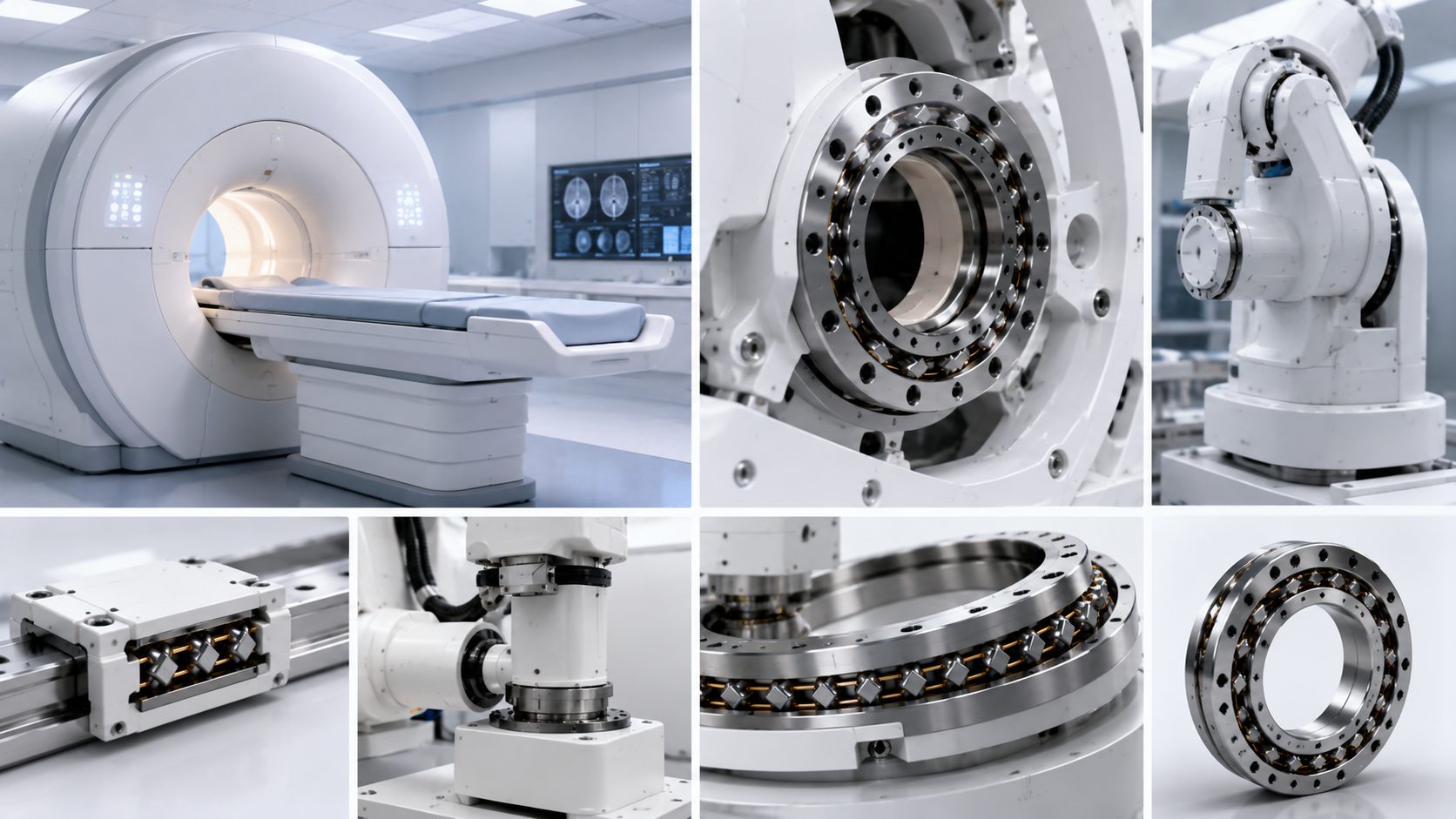
Crossed roller bearings medical imaging equipment operates under a unique set of demands. It must move patients and detector arrays with micron-level repeatability. It must do so quietly, because a noisy bearing in an MRI suite disturbs both patients and staff. And it must last for millions of cycles without maintenance because downtime in a hospital imaging center means delayed diagnoses and rescheduled appointments. Crossed roller bearings fulfill these demands through a combination of high stiffness, smooth motion, and long service life in a compact form factor.
Three core medical imaging applications depend on crossed roller bearings: CT scanner gantries that spin X-ray sources around patients at several hundred RPM, MRI patient table positioning systems that move patients into the magnet bore with sub-millimeter accuracy, and C-arm X-ray pivot joints that allow clinicians to reposition the imaging head around the patient from multiple angles. Each application stresses the bearing differently, but all three benefit from the crossed roller architecture.
TORQUE VARIATIONSUB-MM
POSITIONING ACCURACY3T
MRI MAGNET FIELDMILLIONS
SERVICE CYCLES
01CT Scanner Gantry Rotation
A CT scanner gantry spins an X-ray source and detector array around the patient at speeds that can reach several hundred RPM. The bearing supporting this rotation handles a combined load: the radial weight of the rotating assembly, which can be substantial, plus the moment load from the cantilevered detector and source mounted on opposite sides of the gantry ring. A crossed roller bearing with its orthogonal roller arrangement handles both load components in a single ring, reducing part count and assembly stack height compared to a two-bearing solution.
TORQUE CONTROL
Low, Consistent Running Torque
Torque variation shows up as speed ripple in the gantry rotation, which blurs the reconstructed image because the reconstruction algorithm assumes constant rotational speed. Crossed roller bearings with precision-ground raceways and matched roller diameters keep torque variation within narrow limits, typically under 10 percent of mean running torque across a full 360-degree rotation. Some high-end CT systems specify torque variation under 5 percent.
Noise control matters inside the scan room. Patients lying inside a CT gantry are already anxious. A bearing that whines or rumbles adds to that anxiety and can cause motion artifacts in the scan from patient movement. The rollers in a crossed roller bearing are separated by spacers or a cage, which eliminates roller-to-roller sliding contact and the associated high-frequency noise. Paired with a low-noise grease formulated for medical environments, the bearing contributes almost nothing to the overall acoustic signature of the gantry. The dominant noise sources in a CT scan room are the cooling fans and the rotating anode in the X-ray tube, not the bearing.
Service life in a CT gantry is measured in scan counts, not hours. A typical hospital CT scanner performs thousands of scans per year. Over a ten-year service life, the gantry bearing accumulates hundreds of thousands of scan cycles, each one including a ramp-up to full speed, a steady-state imaging period, and a deceleration to stop. This stop-start duty cycle is harder on the bearing than continuous rotation because the lubricant film must re-establish each time the bearing starts from rest.
02MRI Patient Table Positioning
MRI systems use linear motion stages to position the patient table. The table moves the patient into the bore with sub-millimeter positioning accuracy so the scan slice lines up with the anatomy of interest. Crossed roller bearing linear guides provide the straight-line motion with high stiffness and zero clearance, which matters when the patient table extends fully into the bore and creates a large cantilever load.
SAFETY CRITICAL
Non-Magnetic Materials Required
The bearing cannot contain ferromagnetic materials that would be pulled toward the magnet bore — a modern 3-tesla MRI magnet exerts forces strong enough to turn a loose steel bearing into a projectile. Crossed roller bearings for MRI applications use stainless steel races, typically austenitic grades that remain non-magnetic after processing, and ceramic rollers made from silicon nitride or zirconia. The cage is PEEK or another engineered polymer. Every component is selected for zero magnetic permeability.
The table must also handle off-center patient weight. A patient positioned near the edge of the table creates a significant roll moment on the linear guide. Crossed roller arrangements resist this moment far better than recirculating ball guides of similar size because each roller makes line contact across its full length rather than point contact. The line contact distributes the load over a larger area, reducing the contact stress and extending the guide life under asymmetric loading.
03C-Arm X-Ray Pivot Joints
A C-arm X-ray system pivots the imaging head around the patient on two orthogonal axes. The pivot bearings hold position precisely when the operator releases the lock, allowing smooth manual repositioning without drift. Crossed roller bearings are well-suited here because they combine high static moment capacity with low and predictable breakaway torque. The surgeon or radiologist can reposition the C-arm with one hand and the image stays exactly where it was left.
The bearing also isolates vibration from the floor. Mobile C-arms roll between operating rooms, and the floor is never perfectly flat. The crossed roller pivot bearing absorbs slight frame twist without binding, keeping the image receptor aligned with the X-ray source. A ball bearing pivot with point contact would be more sensitive to frame distortion and would show increased torque when the C-arm rolls over an uneven floor seam.
APPApplication Comparison
| Characteristic | CT Gantry | MRI Patient Table | C-Arm X-Ray |
|---|---|---|---|
| Motion Type | Continuous rotation | Linear positioning | Pivot on two axes |
| Key Requirement | Low torque variation (<10%) | Non-magnetic materials | Low breakaway torque |
| Material Constraint | Low-noise grease, spacers | Austenitic steel + ceramic rollers + PEEK cage | Standard bearing steel |
| Load Characteristic | Radial + cantilever moment | Cantilever + off-center roll | Static moment + vibration |
04Sterilization and Cleanroom Compatibility
Medical imaging equipment sees regular cleaning with disinfectant solutions. The bearing seals need to resist chemical attack from these cleaning agents, which can include quaternary ammonium compounds, hydrogen peroxide, and isopropyl alcohol. Nitrile rubber seals provide good chemical resistance for most hospital-grade disinfectants. Fluoroelastomer seals offer better chemical resistance and higher temperature capability but at higher cost. The seal material choice should be confirmed with the disinfectant manufacturer compatibility data before specifying the bearing.
For cleanroom assembly environments common in medical device manufacturing, crossed roller bearings can be supplied with low-outgassing grease and vacuum-compatible packaging. This keeps particle counts low during equipment build. Some applications specify NSF H1 food-grade grease even though medical imaging equipment does not contact food, because H1 grease has been tested for incidental human contact and provides an extra margin of safety in a patient environment.
Related: Crossed Roller Bearings, stainless steel options | Custom Solutions
Get a Quote
Yuanhe manufactures crossed roller bearings with stainless steel and ceramic material options for medical applications. Request a quote with your load and space envelope requirements.