


 English
 French
 German
How to Choose a Crossed Roller Bearing for Your Application
How to choose crossed roller bearing involves more than matching the bore size to the shaft diameter. The bearing must support the full load spectrum, meet the accuracy target for the application, run at the required speed without overheating, survive for the intended operating life, and fit within the space and cost limits of the machine design. Get one of these parameters wrong and either the bearing fails early or the machine fails to meet its performance specification, both of which lead to the same outcome: a redesign and a delayed launch.
This guide organizes the bearing selection process around five sequential questions. Answer them in order, collect the data each question requests before moving to the next, and by the end you will have defined the bearing envelope, accuracy grade, preload class, sealing configuration, and mounting style. The five questions apply to crossed roller bearings used in rotary tables, robot joints, positioning stages, and similar precision rotary axes.
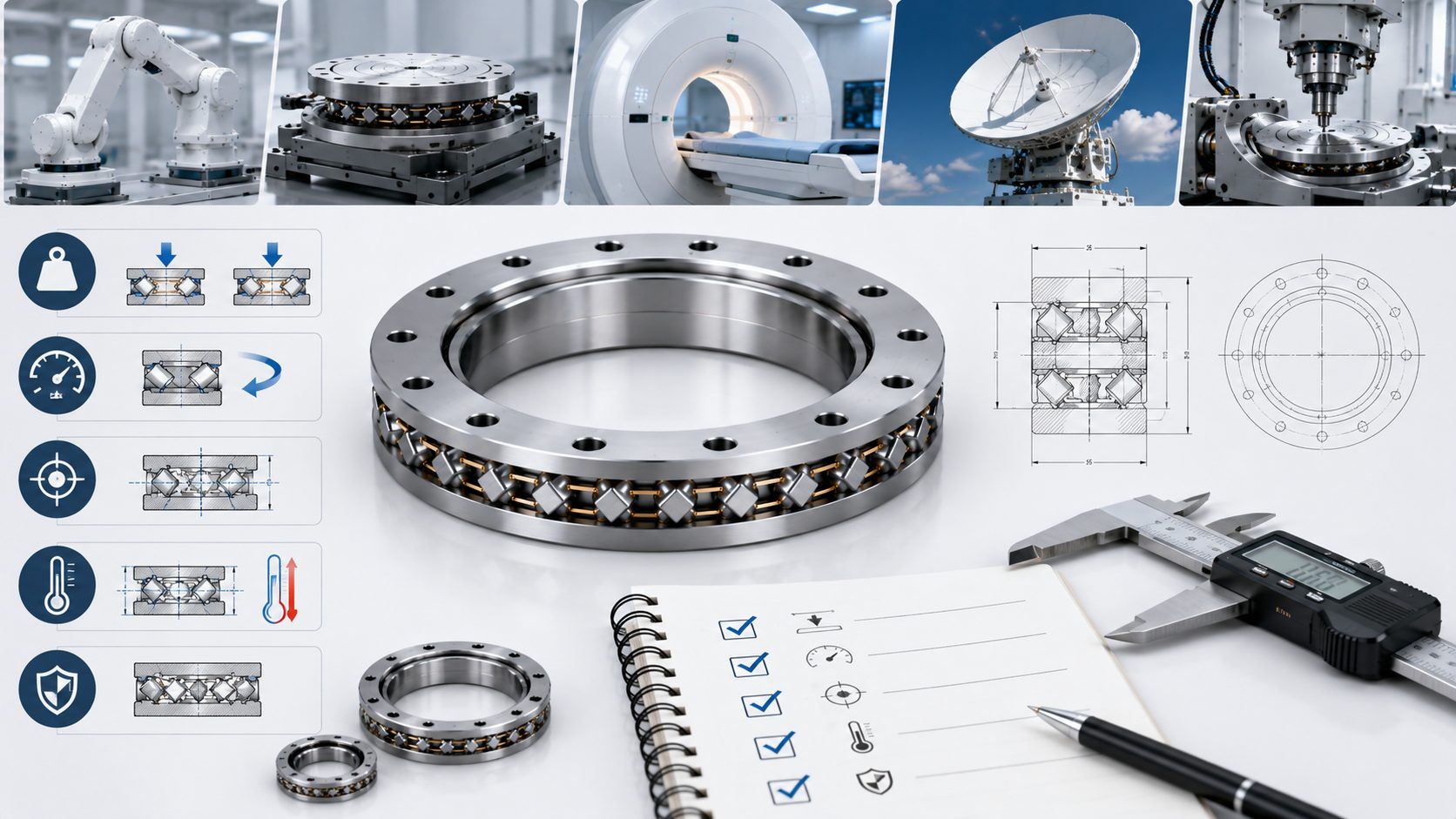
Crossed roller bearing (3D visualization): crossed cylindrical rollers between steel-blue rings provide high rigidity under combined radial, axial, and moment loads.
Selection Checklist
1What loads does the bearing see?
2What accuracy grade is required?
3What preload class fits the application?
4What sealing and lubrication does the environment require?
5How will the bearing be mounted?
Q1What Loads Does the Bearing See
Start with the load case. A rotary axis experiences some combination of three load components: radial load pushing perpendicular to the rotation axis, axial load pushing along the rotation axis, and moment load trying to tilt the rotating ring relative to the stationary ring. A robot wrist joint carrying a gripper and a payload at the end of an extended arm sees predominantly moment load from the cantilevered weight. A rotary indexer supporting a heavy fixture centered directly above the bearing sees predominantly axial load. A belt-driven spindle sees predominantly radial load from the belt tension pulling sideways on the shaft.
Calculate or estimate the maximum load in each of the three directions. Include dynamic factors: acceleration and deceleration forces during indexing moves, impact loads when a tool engages the workpiece, off-center loading that creates additional moment, and any external forces from cables, hoses, or adjacent mechanisms that pull on the rotating assembly. The bearing catalog lists dynamic and static load ratings for radial, axial, and moment directions. Select a bearing where the maximum applied load in each direction falls below the corresponding dynamic load rating, with a safety factor appropriate to your industry and application.
KEY DECISION
Moment Rating Often Sets the Size
For crossed roller bearings specifically, the moment load rating often determines the bearing size rather than the radial or axial ratings. A bearing with a small diameter may have adequate radial and axial capacity but insufficient moment capacity for a cantilevered load. This happens often in robot joint applications where designers size the bearing based on the hollow shaft bore diameter required for cable pass-through, then discover that the moment rating at that bore size is marginal. Always check the moment rating against the worst-case overturning moment, including the distance from the bearing center to the load center of gravity.
Q2What Accuracy Grade Is Required
Crossed roller bearings are manufactured to accuracy grades that specify radial runout, axial runout, and bore and outer diameter tolerances. The grades typically follow ISO or equivalent national standards with designations such as P0, P6, P5, P4, and P2 in order of increasing precision. For general automation where the rotary axis indexes parts between stations with a relaxed positioning tolerance, a standard accuracy grade is sufficient. For machine tool rotary axes, where runout at the bearing translates directly into part geometry errors at the cutting tool, specify a high-precision grade.
KEY DECISION
Accuracy Cost Scales Steeply
A P4-grade crossed roller bearing may cost significantly more than a P0-grade bearing of the same size. Before specifying the highest available grade, ask whether every component in the load path can hold a tolerance that tight. A P4 bearing mounted on a housing face machined to insufficient flatness will not deliver P4 runout at the rotating table surface. The bearing runout specification is only one contributor to the total system runout. Housing flatness, shaft perpendicularity, bolt torque consistency, and thermal gradients across the structure all add their own error contributions.
Q3What Preload Class Fits the Application
Preload removes internal clearance and increases stiffness, as covered in detail in the preload article earlier in this series. The preload class choice boils down to a trade between stiffness and heat. Light preload is correct for inspection and measurement axes where speed matters more than stiffness, or where the bearing runs at higher RPM and heat generation must be minimized. Medium preload is the most common choice for machine tool rotary axes and robot joints, providing a practical balance of stiffness and acceptable running torque. Heavy preload is reserved for applications where deflection tolerance is near zero, typically grinding spindles, diamond turning machines, and optical alignment fixtures.
Check the speed rating at your chosen preload class. Heavy preload bearings have a reduced maximum speed because of the additional heat generated by the higher roller-to-raceway contact stress. If your application runs at more than a large fraction of the catalog speed limit for the chosen preload class, consider dropping to the next lighter preload class or adding active cooling to the bearing housing. A bearing running at its thermal limit leaves no margin for variations in ambient temperature, grease condition, or seal drag as the bearing ages.
Q4What Sealing and Lubrication Does the Environment Require
The working environment determines the seal type and the grease specification. A clean indoor environment with moderate ambient temperatures can use standard nitrile rubber seals and a general-purpose lithium grease. A wet environment with coolant spray or washdown cleaning requires contact seals on both sides of the bearing, with the seal lip material selected for chemical compatibility with the specific fluids present. High-temperature environments need fluoroelastomer seals and synthetic grease with high oxidation stability. Vacuum or ultra-clean environments need solid lubricant coatings or perfluoropolyether greases with near-zero outgassing.
KEY DECISION
Add Fittings if the Bearing Is Hard to Reach
If the bearing is difficult to access after installation, such as a bearing buried inside a machine frame or behind multiple covers and panels, specify seals with a relubrication feature: a grease fitting on one face and a relief port on the opposite face. This allows you to purge old grease and inject fresh grease without disassembling the machine. The small added cost of the fittings is recovered the first time you relubricate without removing guarding, covers, and adjacent components that would otherwise require hours of disassembly and reassembly.
Q5How Will the Bearing Be Mounted
Crossed roller bearings come in several mounting configurations, and the choice affects both the initial assembly and future replacement procedures. Bearings with integral mounting holes in both rings bolt directly to the housing and shaft flanges. These are the most common type and the easiest to install and replace. Split-ring bearings with clamp collars allow radial position adjustment during assembly, which is helpful when the housing cannot be machined to an exact fit tolerance. Press-fit bearings without mounting features save radial space and weight but require precise housing and shaft fits, and removal typically requires bearing pullers, heat, or both.
The mounting configuration also affects the replacement strategy. Bolted bearings can be removed and replaced during a short maintenance window by loosening the fasteners and lifting the bearing out. Press-fit bearings often require partial disassembly of the machine to access the bearing for removal. If the bearing is in a production machine that runs three shifts, the bolted configuration can pay for its slightly higher cost in avoided downtime the first time the bearing is replaced. For applications where bearing replacement is expected to be infrequent and the machine design prioritizes compactness, the press-fit configuration may be the right trade-off.
SUMSelection Summary
| Question | Decision Variable | Key Tip |
|---|---|---|
| Q1 Loads | Radial / axial / moment | Moment rating often sets the size |
| Q2 Accuracy | P0 / P6 / P5 / P4 / P2 | High grade costs steeply — check system tolerance |
| Q3 Preload | Light / medium / heavy | Heavy preload lowers max speed |
| Q4 Sealing | Seal + grease type | Hard-to-reach bearings need grease fittings |
| Q5 Mounting | Bolted / split-ring / press-fit | Bolted is easiest to replace |
After going through all five questions, you will have defined the bearing envelope, accuracy, preload, sealing, and mounting configuration. At this point, contact the bearing supplier with your answers and request a specific part number recommendation, a stiffness curve for your preload class, and a confirmation of lead time and minimum order quantity. The supplier can also check whether your estimated bearing life meets your application requirement and suggest adjustments if the initial selection falls short.
Related: Crossed Roller Bearings | Deep Groove Ball Bearings | Engineering Support
Get a Quote
Yuanhe application engineers can walk through these five questions with your design team and recommend a crossed roller bearing matched to your load, accuracy, and cost targets. Contact us to start the selection process.