


 English
 French
 German
Crossed Roller Bearing Preload What It Is and Why It Matters
Engineering Brief
Crossed roller bearing preload is the single most misunderstood parameter in crossed roller bearing selection. Preload removes the internal clearance inside the bearing so that every roller contacts both raceways before any external load is applied. That simple change transforms bearing stiffness from a soft progressive curve into a near-linear response. The practical implications ripple through every aspect of machine design: stiffness, running torque, heat generation, speed capability, and fatigue life.
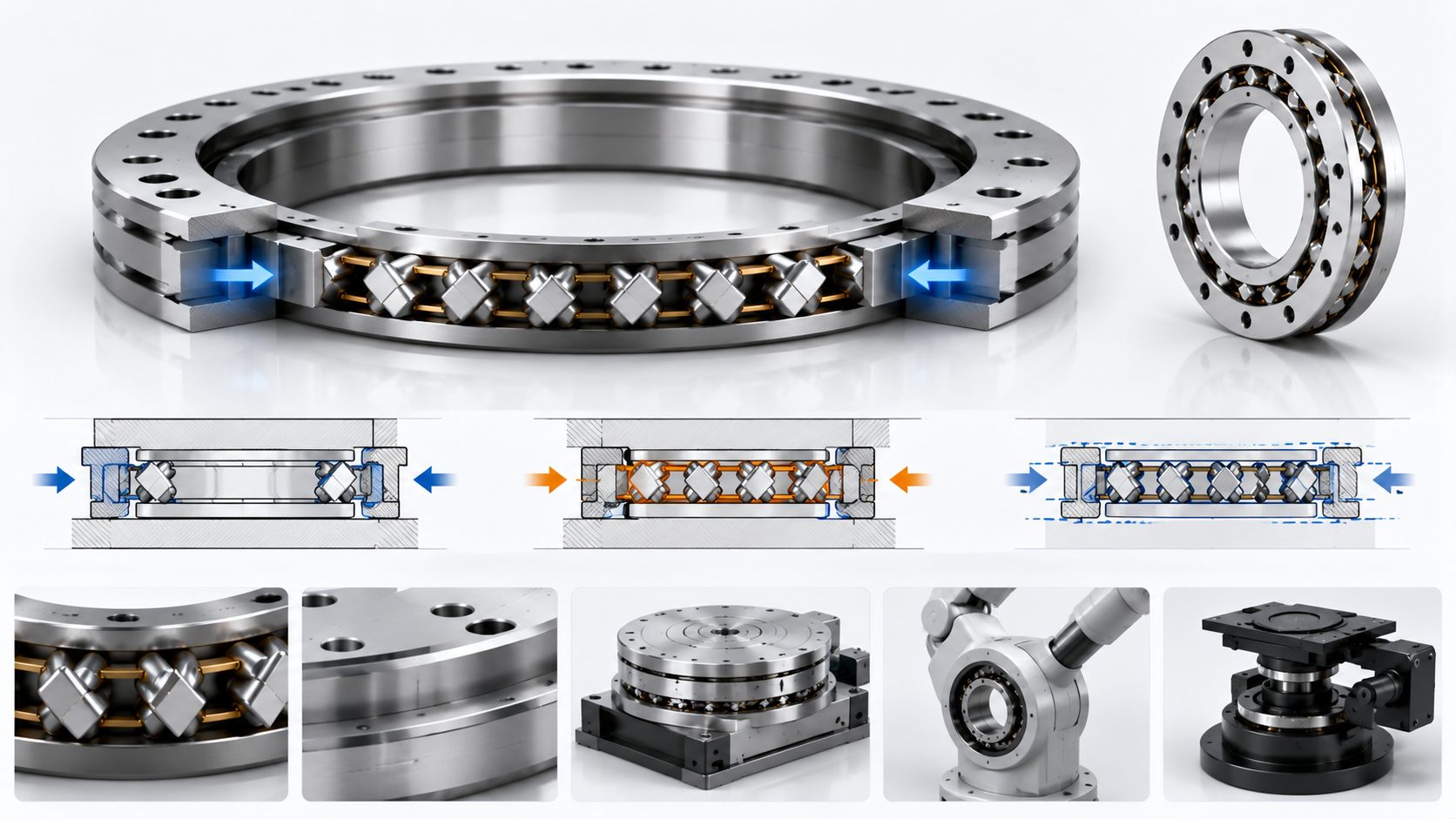
Why does preload matter? In a positioning stage, clearance in the bearing shows up as lost motion. The stage moves a few microns before the bearing actually starts resisting the load. In a milling spindle or rotary table, clearance allows the cutting tool to deflect under load, producing tapered holes and poor surface finish. Preload eliminates that dead zone by ensuring that every roller is already under compression when the bearing is at rest. The first newton of external load is resisted immediately, not after the clearance closes.
Proper crossed roller bearing preload delivers the stiffness and accuracy that precision machinery demands. Here is how it works inside the bearing.
How Preload Works Inside a Crossed Roller Bearing
A crossed roller bearing has cylindrical rollers arranged at 90 degrees to each other in a V-shaped raceway. Without preload, there is a small gap between some rollers and the raceway surface, controlled by the bearing internal clearance class. This gap is necessary for assembly and to accommodate thermal expansion during operation. When you apply a radial or moment load to an un-preloaded bearing, only a portion of the rollers carry the load. The rollers on the unloaded side contribute nothing to stiffness because they are not in contact with the raceway.
With preload applied, every roller is compressed slightly against both raceways. The compression is achieved either by building the bearing with rollers slightly larger than the space between the races, or by applying an axial force through a spring or adjustment nut that squeezes the races together. When an external load arrives, the preloaded rollers on the loaded side see increased compression while the rollers on the opposite side see reduced compression. Because all rollers are already in contact, the load is shared across a larger number of rollers. The deflection for a given load is lower, and the stiffness-versus-load curve is linear rather than progressive.
Key Insight
An un-preloaded bearing deflects significantly at low loads because it must first close the internal clearance. Once the clearance closes, stiffness jumps to a higher value. A preloaded bearing skips the soft region entirely and operates in the stiff region from the first newton of applied load. For a positioning system that must hold micron-level accuracy, this is the difference between hitting the target and missing by several microns every time the load changes.
The stiffness gain from preload is not linear. Going from zero preload to light preload produces the largest stiffness increase because it closes the clearance gap. Going from light to medium preload adds more stiffness but the incremental gain is smaller. Going from medium to heavy preload produces the smallest stiffness gain per unit of added preload force. There is a diminishing return, and beyond a certain point the added preload mainly increases friction and heat without delivering meaningful additional stiffness.
Preload Classes and How to Choose
Crossed roller bearings are offered in several preload classes, typically designated as light, medium, and heavy, or by alphanumeric codes that vary between manufacturers. A light preload, sometimes called clearance-free or zero-clearance, removes the internal gap without introducing significant additional friction. The running torque is close to the bearing baseline torque. This is the right choice for applications where speed matters and stiffness is secondary, such as a rotary table used for inspection or light assembly, or a positioning stage that moves at high speed between measurement locations.
Preload Class Comparison
LLight preload — Removes internal clearance. Torque near baseline. Best for inspection rotary tables, light assembly, and high-speed positioning stages where stiffness is secondary.
MMedium preload — Defined negative clearance. Noticeably higher stiffness and torque. The most common choice for machine tool rotary axes. Balances stiffness and manageable heat generation.
HHeavy preload — Maximum stiffness. Significantly higher torque and heat. Reserved for grinding spindles, diamond turning, and optical fixtures that cannot tolerate even a micron of deflection.
Medium preload adds a defined negative clearance, meaning the rollers are compressed beyond the zero-gap condition. Each roller is elastically deformed by a few micrometers. This increases stiffness noticeably and raises running torque by a similar percentage. Medium preload is the most common choice for machine tool rotary axes because it balances stiffness and heat generation. The added torque is small enough that a direct-drive motor can overcome it without derating, and the added heat can be managed with natural convection from the bearing housing.
Heavy preload squeezes the rollers with significant force depending on bearing size. Stiffness is maximized, often reaching notably higher than a light-preload bearing of the same size. But running torque goes up substantially compared to medium preload. Heat generation increases with torque, so the bearing must operate at lower speeds or with additional cooling. Heavy preload is reserved for applications where stiffness trumps everything else: grinding spindles, diamond turning machines, and optical alignment fixtures that cannot tolerate even a micron of deflection under load.
Preload, Speed, and Thermal Effects
There is a trade-off between preload and speed. Higher preload increases rolling friction, which generates more heat at a given RPM. The bearing manufacturer specifies a maximum speed for each preload class based on the thermal balance point where heat generation equals heat dissipation through the housing. Running above this speed with heavy preload can cause the bearing temperature to climb until the grease oxidizes or the races expand enough to increase preload further, creating a thermal runaway condition.
Preload also interacts with differential thermal expansion. If the bearing housing is aluminum and the shaft is steel, the aluminum housing expands more as temperature rises. This expansion increases the effective preload beyond the room-temperature setting, raising torque and potentially overloading the bearing. Applications with wide temperature swings, such as outdoor equipment or machines that cycle between cold startup and hot running conditions, need a preload margin that accounts for this differential expansion. The bearing manufacturer can calculate the preload change for your specific housing and shaft material combination.
Starting Point
For most general machine tool and automation applications, medium preload is the safe starting point. It delivers enough stiffness for precision work without pushing the bearing into excessive torque and reduced life. If prototype testing shows insufficient stiffness, move up to heavy preload. If the bearing runs too hot or the motor current is higher than expected, drop to light preload. Change only one variable at a time.
Related: Crossed Roller Bearings, multiple preload classes | Application Support | Deep Groove Ball Bearings
Get a Quote
Yuanhe offers crossed roller bearings in multiple preload classes. Share your stiffness target and speed range with our application team for a preload recommendation.